Metro-Gaming
Usually, planning an outside function in Las Vegas is as close as a sure bet as you can get. With about 300 days of sunshine each year, the owners of the (then) Cosmopolitan Resort & Casino didn’t expect October 25, 2005 to dawn gray and wet. But that was exactly what happened. Organizers were forced to shepherd hundreds of guests into the trailers that served as the sales pavilion as the rain poured down outside.
The impromptu ceremony featured speeches and presentations from players who were nonetheless optimistic that the Cosmopolitan would be a success. On that day, the teeming rain didn’t seem to be a bad omen, just a temporary inconvenience.
And then the recession hit.
It started slowly but reached critical levels quickly. Some of the Strip’s most high-profile developments—planned or under construction—were halted. Condo projects, which was an important element of the Cosmopolitan, were hardest hit.
But the Cosmopolitan soldiered on. Even when the first set of owners ran out of money, the lender, Deutsche Bank, continued funding the construction. After some fits and starts and a new name, the Cosmopolitan of Las Vegas debuted in December 2010 to plaudits and applause from many visitors and design experts. Occupancy rates and ADR have been off the charts. The “buzz” factor has been incredible. And the Strip now has a new “must-see” attraction. But then we’re getting ahead of ourselves.
Birth of an Idea
The Cosmopolitan Resort & Casino was spawned by New York real estate developer Ian Bruce Eichner and former Las Vegas Sands executive David Friedman. Along with other partners, they had an idea to bring a new stylishness to the Strip that would be unlike anything experienced in Las Vegas.
But the site had to be right, and that turned out to be tricky. At that time on the Strip, development had pushed up the prices of land to something like $20 million an acre for prime real estate, so finding the “location, location, location” was a challenge.
It soon became apparent that a plot of land between Bellagio and the soon-to-launch CityCenter fit the bill. The only problem was the size. At 8.7 acres, it clearly was undersized for a major Las Vegas resort.
Brad Friedmutter, the president of the Friedmutter Group, was there from the start. He says the owners considered several different locations before making the final decision.
“It was the right ‘neighborhood,’” says Friedmutter. “There were other, larger, sites, but this one had the right pedigree.”
With experience in all jurisdictions, Friedmutter says the only place lacking on his résumé was the Las Vegas Strip.
“So we were very excited about getting this project,” he says. “And not just any project, but such a significant project.”
The initial construction was complicated. Excavation went down 10 stories below the Las Vegas Strip, with walls thick enough to stand on their own.
“It’s like an upside down building with another building sitting on top of it,” says Friedmutter.
But as the economy worsened, Friedman and then Eichner (along with one of the original designers, Arquitectonica) exited the project, leaving Deutsche Bank with an important decision to make: stop construction or finish the job.
When the company decided to proceed, Deutsche Bank brought in the Related Group to handle the logistics of coordinating the final design and construction plans. The company has vast experience coordinating such projects, but time was of the essence.
Ron Wackrow, executive vice president of Related, says it was a good marriage.
“We’re a New York company and we have extensive experience in this kind of construction,” he says.
That experience extended to working with the best designers in the world, and one of the first to be retained by Wackrow was David Rockwell, who has extensive gaming background, having been recognized with the Sarno Award for Lifetime Achievement presented by the American Gaming Association in 2008.
One of the first decisions made by Wackrow and his team was to move the casino, which was placed on the second floor in the original plans, down to the first floor and adjacent to the Strip.
“Having worked on gaming projects in the past, we realized that the location of the casino was a problem right from the start,” says Wackrow. “When we considered where to move it, it just opened up some great options. That decision changed many of the elements you see today. First of all, it reduced the amount of retail, which we realized was too much, so it accomplished two goals. By putting the casino on the first floor, we were able to create an immediacy that works very well in the final product.”
Friedmutter agrees that the decision was a good one.
“When Related came in, we decided the casino should go to the Strip, which opened up the retail area to create the three-story element that became the Chandelier Bar.”
John Unwin, CEO of the Cosmopolitan, believes the decision transformed the entire property.
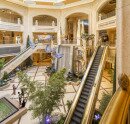
“It put the lobby and the front desk in the right place,” he says. “It also helped to ‘right-size’ the retail offerings. We have about 65,000 square feet of retailers. We see them as luxury redefined. The super high-end logos wouldn’t work in here. So we really had the opportunity to find some unique retail offerings that are not as widespread as the other luxury brands. It was the right thing to do to concentrate on 13 or 14 shops rather than create another mall.”
Central Feature
The re-design of this space opened
up an atrium area that attracted Rockwell and became the signature of the Cosmo-politan.
“The space that eventually became the Chandelier was supposed to be a feature that would be a central draw,” he says. “Las Vegas is defined by change, and we believe this is a reinvention of what Las Vegas is. And it’s not just one thing—gaming, entertainment, dining, retail—it’s a combination of all those things that create a unique experience.
“At the Cosmopolitan, we felt there was an opportunity to represent this, particularly because of how vertical it is.”
Using that verticality, Rockwell says that the Chandelier “gives people the thrill of inhabiting something as dramatic as a chandelier.”
That required a larger hole that extended the vertical feature in a wider circumference, extending to the second and third levels.
“We designed the ways to move through the space in that area,” says Rockwell, “so it was exciting to look at from the outside and from the inside.”
Unwin says the creation of the Chandelier reflected the cooperation that was necessary throughout the project.
“The design of the Chandelier Bar was done in a collaborative fashion with the lab at Rockwell,” he explains. “The furniture, fabrics, crystals, even down to the images we project on the crystals were all done together.”
Rockwell says the inspiration for the space was to define the entire Cosmopolitan experience.
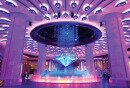
“The chandelier is the object that is the epitome of what the Cosmopolitan stands for,” he says. “It attracts and pulls you through the casino from either direction. The access to the casino is nearby and the chandelier is a fantastic symbol of glamour. Making it big enough to actually inhabit, it would be both familiar and surprising.”
Wackrow says the Chandelier was a labor of love.
“We really liked the concept,” he says, “but it was going to be difficult to pull off. First, the delicacy of the crystal strands had to be addressed, and then, how the people flow through the feature became an issue.”
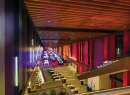
By creating a mid-level lounge above the main floor but below the mezzanine, visitors feel secluded and exclusive, but still a part of the action.
As for the chandelier itself, Rockwell says they went through several iterations for the beads. Once they settled on them, how to hang them became a challenge.
“The beads are threaded through steel cables,” he explains. “The cables are designed to hold a certain amount of weight, but then detach if too much weight is put on them.”
Beautiful and strong.
Access Issues
With a small footprint, the 2,995-room Cosmo-politan was bound to break some Las Vegas rules. The first one had to be the placement of ingress and outflow for vehicles. Chuck Jones, a senior vice president with the Friedmutter Group who was actively involved in the original designs, says the decision of how to deal with the porte cochere wasn’t a difficult one.
“We looked at several locations,” he says. “We knew we wanted to maximize useful building square footage on the site, and we also knew we wanted to keep the Strip open for pedestrians, so anything with vehicles had to be on the west end. That was simply the rationale.”
But for firms with experience in construction in major cities, the Cosmopolitan was simply another vertical building. Jones says this would not be the first time that the designers broke a Las Vegas tradition.
“While this broke the paradigm in Las Vegas, it exists in any major metropolitan city, so we were confident it would work here,” he says.
Unwin says he was concerned about the flow of vehicle traffic, but he needn’t have been.
“It’s so different than what people are used to in Las Vegas,” he says. “But so much thought and effort was put into what we perceived to be a challenge, I think it actually has been a positive for
us. I felt pretty comfortable with it, but I didn’t think it would actually turn into an advantage.”
The verticality of the hotel minimizes the physical spaces that confront visitors. Unwin says the multi-level, subterranean parking garage whisks visitors from their cars to the casino, restaurants or entertainment options in seconds.
He also believes the “walkability” of the project and the access to the Strip has become a huge advantage.
“I don’t think anybody has embraced the Strip in this way for many, many years,” he says, “particularly at this end of the Strip. Every day, there are 60,000 to 90,000 people walking in front of our property. That’s been tremendous exposure for us, coupled with the relative ease of getting in and out through the two vehicular entrances. This has really been received well by customers.”
Many of those customers are Las Vegas residents who appreciate the ease of access.
“We’ve got some great support from the local community in Las Vegas,” he says. “They appreciate the indie spirit we bring to the Strip. It makes it more interesting for them and their guests when they’re showing them the Strip.”
Market Function
Though the general market of the Cosmopolitan had been identified early on, it wasn’t until Unwin joined the project in 2008 that the target audience was clarified. And it’s that audience that influenced the design of everything from that point on.
Unwin’s description of the typical Cosmopolitan customer was the catalyst for creativity from many of the designers.
“Part of what we were trying to create was a market opportunity and a customer we call the ‘curious class,’” says Unwin. “And central to the needs of these customers is to create a sense of exploration, so that as you go around every corner, there’s something new and interesting there. That’s how the restaurant neighborhood was set up. That’s how our art program was set up, from the ‘art-o-mat’ machines to the 7-foot-tall high heel in the commons area.”
Wackrow says that when Related was hired, it was crucial to understand who the customer was.
“We wanted to examine what we thought the DNA of the Cosmopolitan would be,” he says. “We envisioned a building that had a sense of performance, that was able to change and transform.”
Rockwell wanted to deliver his signature touches to an audience who would appreciate them.
“They (Cosmopolitan executives) knew that this was going to fall in between the adventurous traveler who wants a boutique hotel and the frequent visitor to Las Vegas who wants a sense of luxury,” he says. “It became very clear as we went on that they believed this was an opening in the market they wanted to fill.”
Unwin says the response from the design group after he clearly outlined who the Cosmopolitan customer would be was dramatic.
“Once we clearly articulated what our brand was, the team we assembled truly understood,” he says. “It was like a light went on and it made the decision-making process that much easier.”
Up and Down
The small site of the Cosmopolitan has created a large hotel with a small feel. The idea an almost 3,000-room property is referred to as a “boutique” hotel seems rather ludicrous, but Unwin says it was essential to the property’s success.
“It was critical to establish the boutique feel,” he says. “The footprint is so small it creates a much more intimate feeling.”
The verticality of the property was an element that could have turned into a negative. In fact, it was an established fact in Las Vegas that you can’t force customers to move up more than one floor (not counting the rooms, of course). So the design of the property was essential to get around what turned out to be an old wives’ tale. Friedmutter says the plan was to turn this into a plus.
“It adds to the complexity, but we believe that being able to go up and down via an escalator rather than have to walk long distances was going to be an advantage, and I think in practice it is,” he says.
Most daring was the plan to put the Cosmopolitan’s signature restaurants on the third floor of the podium, an element that flew in the face of conventional Las Vegas wisdom. Unwin had a germ of an idea that would transform this negative into a positive by using the center space between the restaurants as an attraction.
“John Unwin asked us to come up with some concepts for that space,” says Rockwell. “He envisioned it as a front porch to all the restaurants.”
The area is now one of the most popular in the hotel, with games, books and music.
“The P3 Commons is activated by creating little vignettes with the pool table, the reading area, the music room… The whole area becomes energized,” says Unwin. “That was a real collaborative idea that included our restaurant partners, Ron, Brad and David and their teams. We believe this will really satisfy the needs of the curious class.”
Flexible Space
Although downsized since the original design, the retail at the Cosmopolitan consists of an eclectic group of stores and shops that appeal to that “curious” class.
“These retail establishments maybe have a shop in Los Angeles and here, or London and here,” says Unwin. “These aren’t the chains you’d see at most malls.”
Stores like British brand AllSaints, Dutch design shop Droog, the ultra-exclusive Beckley boutique, the sexy Molly Brown’s Swimwear and others are shops that can’t be found anywhere else in Las Vegas.
Again, because of the small size of the parcel, every square inch of the public space at the Cosmopolitan must be utilized as much as possible. Therefore, the meeting space, clubs and pool areas had to be designed as multi-use facilities.
“Flexibility and mixed use was a main part of our mission,” said Friedmutter. “We wanted to be able to use every part of the building 24 hours a day.”
The pools are all used for various functions.
“We can convert the Boulevard Pool to an entertainment venue very quickly,” he says. “It resonates with people. To watch a concert played on our 65-foot marquee and to look up and down the Strip at the same time is something you can’t experience anywhere else in Las Vegas.”
Marquee Dayclub, an adult pool experience, doubles as an extension of Marquee nightclub. And with other special touches, the pool is almost always active.
“The Marquee pool has cabanas with infinity pools in each and three-story bungalows behind them that are really super suites,” explains Unwin.
Friedmutter believes that by placing the pools on different levels, it becomes a positive.
“Having the pool decks on the roof actually became an advantage because it removed it from the ground plane and offered exclusivity at the various pools,” says Friedmutter’s Jones. “The three areas are very different, and cater to families and adults and also create a party zone. And then when you add the concert and club venues, at night, it’s a winner. There’s a huge financial investment up there, and the more you can stretch those operating hours and create revenue from them, the better.”
It is those pool cabanas that actually influence one of the unique designs on the casino floor. The “gaming cabanas” are a series of slot machines contained by draperies or hanging beads that create intimate areas on a larger casino floor.
“Because of the volume of the space, we knew we needed to bring some sort of element in that helped humanize the space,” says Jones.
The long and narrow nature of the casino allowed designers to create a flow that fulfilled Unwin’s goal of a “surprise around every corner.”
“The floor is a series of smaller villages,” says Jones. “The clusters of table games, the high-limit areas, the slot groupings are more intimate, and then you transition to the Chandelier Bar and beyond. It really worked out well to reduce that large, big-box gaming floor to special areas where people can find their own niche.”
Another negative-turned-positive is the solution for the many columns necessary in a tall, narrow building. In many areas, particularly in the West Lobby, the columns are clad in a high-definition technology that creates a different atmosphere as the images change, from branding messages for the hotel to unique artwork designed by various artists.
“One of the things done to take advantage of what would have been a negative was creating the video columns, which display artwork specifically designed for them,” says Unwin. “It supports the brand, and at the same time shows a true boutique feel—and directs visitors to the attractions of the property. The flow we designed from the lobby through the casino to the Chandelier, up to the restaurants, puts new things around every corner. Architects and designers are problem-solvers, and they have exploited our small size in a very positive way.”
Room Product
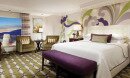
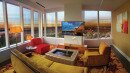
As one of the few Las Vegas casinos with terraces overlooking the Strip, the Cosmopolitan rooms have proven to be very popular. Because the rooms were designed to be condos first and hotel rooms second, the experience is quite unlike anything on the Strip.
“Usually, a balcony is considered somewhat wasted space,” says Wackrow. “We took extra care to blend the outside and the inside furnishings and flow so that they are an important part of the Cosmopolitan rooms.”
Rockwell was given wide latitude in the design of the rooms, although he was constrained a bit.
“The rooms were a product of a past relationship,” says Jones, “which was a great idea, but it was also limiting for the next designer that came in. They had to take an existing room product, where the bones were there, but there wasn’t much else. Rockwell did a fantastic job accessorizing and decorating the rooms.”
Friedmutter, one of the first to buy a Cosmopolitan condo, has firsthand experience with them.
“In essence,” he says, “they’re getting a residence for the price of a hotel room. The room sizes are set up as a residential layout. So you’re getting a hotel room that is a residential product.”
Rockwell says the large area of the rooms made it important to make them different from regular luxury hotel rooms.
“We wanted to create rooms that had luxury, but with a sense of style—a little wink that they don’t take it too seriously,” he explains. “I feel like so much of the luxury hotel market feels like it was bought at the same time out of the same catalog. This was a case where we wanted it to feel collected, curated and layered so you felt like it was assembled over time.”
In the five different styles of rooms, Rockwell worked with different elements and similar restrictions.
“We changed all of the FF&E in the rooms,” he says. “Any lighting changes we did, we had to use exposed conduits. The bars have decorative fixtures above them with the exposed conduits. We had to make a good thing out of the limitation that couldn’t recess any lighting.”
Cosmo Aftermath
Today, the design experience at the Cosmopolitan is one that is cherished by all who took part. Unlike its neighbor, MGM Resorts’ CityCenter, which has been criticized for its excess, the Cosmo-
politan has garnered almost universal acclaim for its sensibilities and
its human scale.
David Rockwell is gracious in recalling the experience.
“It was one of the best experiences I’ve ever had,” he says. “They were very open to new ideas. While they had a strong point of view, they didn’t dictate design, which stops creativity. They challenged us to do the very best work we could do. And because they had to have it quickly, it was a bit of an advantage because it focused everyone.”
Friedmutter was comfortable with the designers selected as part of the team when Related was appointed to direct the process.
“We’ve worked with most of them in the past,” he says. “We’re accustomed to how they work. We’re used to having the designs unique to each designer, but also to blend them all together as a whole. At the Cosmopolitan, it was more important, because you were not just touching ceilings and floors, but the space became more three-dimensional with impacts on every level of design.”
Wackrow believes that the final product stands as testament to the hard work and creativity of the group.
“The team was very cohesive,” he says. “Everyone was willing to do all they could to make sure we got this project done in a way that would guarantee its success. And I think we’re seeing that today.”
For Unwin, who is concentrating on operating the newest luxury property in Las Vegas, predictions that the Cosmo-politan would be the last of the Las Vegas Strip mega-resorts is backwards.
“I don’t believe we’re the end of an era,” he says. “I actually believe we’re the first property in the beginning of a new era which will be partially influenced by what we did here in the design of the Cosmopolitan.”
The Go Zone
The hotel room has always been a place where gamblers could sleep in between the excitement of the casino floor and the showroom. No more. In today’s competitive market, guest rooms are as much of an attraction as the rest of the casino and hotel.
Whether it’s a compact, spare room or a themed suite with 1,600 square feet of space, hotel operators need to make the guest room experience comfortable and memorable. It takes more than fine linens and a 42-inch flat screen to impress today’s sophisticated guest. We will explore current trends in room accommodations that have proven to be successful in increasing guest satisfaction, especially those that create the desire to come back.
A lot of life goes on in a guest room. Jeff McIntyre, principal of premier hotel operator Gemstone Properties, likes to say that a guest room has four zones: the sleep zone, the entertainment zone, the work zone and the wet zone. When planning and evaluating rooms, McIntyre says that each zone needs to be carefully considered to allow each to stand on its own, while not conflicting with the concurrent use of other zones. For example, one guest may want to sleep while the other watches the game. A huge tub as a main centerpiece in a suite may be sexy, but not if the guest wants to use the room for a private business meeting.
As we go through the trends in each zone, it’s important to remember that they need to coexist. Unless specifically desired, as in the case of a themed suite, one zone should not dominate.
The Sleep Zone
Creating the standout room draws upon a palette of both high- and low-tech solutions. When considering the sleep zone, the most important factors will be the low-tech ones. The bed itself should be appropriately sized for the room. A California king in a compact room is not the right choice. Think of circulation around the bed as much as you think of the comfort of the bed itself. Select the right size for the room.
“Mattresses and linens are one of the strongest elements in forming guest impressions,” says Bill Langmade, president of Purchasing Management International. “More time is spent in contact with them than with any other portion of the room. A quality mattress is essential.”
There are now high-end installations where the choice of soft and firm pillows extends to the mattress itself, with adjustable support models. They need to be simple to operate, and long-term maintenance and dependability issues are still shaking out, but from a marketing perspective, these are a distinct bonus. Bed linens should, of course, be high thread-count, natural fibers, and the best you can initially afford to get payback in serviceability and satisfaction.
Think through bed placement. If you have spectacular nighttime views, the bed might want to face the windows. In a more traditional setting, the bed will want to overlook the entertainment zone. Maximize installations that allow control of room elements directly from the sleep zone. Being able to turn off the TV, turn down the lights and close the drapes without leaving the warm world under the covers will make a positive impression on your guests.
The Entertainment Zone
Entertainment is sparkle, showmanship, slick and, when done well, sublime. This is the best area to incorporate high-tech innovation. The communication wires into the room that used to support an analog telephone and “cable TV” are now the pipeline to the outside world. If used intelligently, it is also the pipeline to increased revenues and guest satisfaction.
A high-quality in-room information and entertainment system should offer all of the following: broadcast TV selections; a variety of music channels; premium and on-demand media options; access to front-desk functions like check-out, reservations, event ticketing and program schedules; room service options; in-house marketing and promotions; and the ever-necessary wake-up call.
On top of that not-so-basic platform, you should consider adding internet access, online entertainment gaming, tie-in to your wagering to the extent allowed, and easy accommodation and integration of end-user devices like iPods and iPads.
As you look into the state of the art of these systems, you will discover that vendors differentiate themselves primarily by the interfaces used, and system pricing changes accordingly. Low-cost, entry-level systems based on a TV screen and remote interface will run $500-$600 per key, exclusive of wiring, maintenance and shared revenue costs. Moving up to a keyboard interface will add about $200 per room. A full-blown dedicated touch-screen interface can easily add an additional $1,200 to the per-room cost.
You need to run a financial model to see if the payback is there based upon the services you can sell through an advanced interface, and then also consider if the more intangible “wow factor” is important to your market base. Some hotels’ entire marketing angle is based on high-tech features.
Entertainment does not live by electrons alone, though. Food for the body is as important as food for the brain. The options you’ll be able to offer for in-room dining will be largely dependent on the nature and capabilities of your general food-and-beverage operation. But as concerns the guest room itself, you are in control.
Once the food gets there, where does it go? Have you made a portion of the entertainment zone suitable for comfortable dining? In a small room, nested tables can do wonders. In a suite, the sky is the limit. The point is to plan it in. Don’t let dining be an afterthought with your guests balancing plates on their laps.
Having tricked out your room with the latest and greatest, give a thought to our tired business fellow who wants to sleep while his wife watches the Final Four. You want them to leave from their stay as happy as when they arrived. Arrange the room, and the elements in the room, so that two or more things can happen at once without conflicting. It’s not easy, and it will depend on the particulars of your physical constraints, but a good architect or interior designer can walk you through several tricks of their trade to get the job done.
The Work Zone
The line between work tools and play toys gets fuzzier every day. I’m writing this on my laptop, but tonight I’ll use the same laptop to grab a movie from Netflix, and I’ll patch into my plasma screen to watch it. My wife’s iPad runs spreadsheets on the flight north, and cool jazz on the flight south. It is both simpler and more complicated to accommodate work and productivity functions in the guest room than it used to be. I really don’t need a fax machine in my room, and I want to have to visit the business center only as a last resort when I’m at a resort for any reason.
What the room needs to provide is a convenient, comfortable and ergonomically correct workspace. And it needs to provide connections. Your guest will appreciate the capability to send a file to a remote printer and pick it up at the front desk on their way to a meeting much more than they will having to call the front desk because the printer in their room is hopelessly jammed. A fast connection to the internet will be a business person’s measure of quality, at least for that first hour each day catching up on emails.
The same infrastructure that services the information and entertainment needs will service the electronic needs of the business guest if adequate capacity is built into your network. You can do it with wired ethernet or adequate coverage of wireless access points. You need to make sure, though, that your pipe to the outside is big enough. A single T1 line is just not going to cut it anymore.
Once the connections are taken care of, the place to connect needs to be considered. A wireless network lets your guests work from anywhere in their room without having to worry about a cable reaching. And anywhere may be OK for a quick look at a file. But your business client will also have times where concentrated periods of work in their room are called for.
A comfortable chair and adequate desk space are essential. In smaller rooms, with built-in items along one wall, consider bowing out the built-in to make a deeper worktop. Provide outlets and task lighting. Try to keep this area free of the main traffic aisle in the room. And a stack table stowed under the worktop can do double duty as additional work area—and then a smart dining table for the great steak and a good wine as reward for a hard afternoon’s work.
And in case the Final Four has an afternoon game, you’d better be sure she can watch without disturbing him while he works.
The Wet Zone
Probably we should call the last area the “comfort zone,” because it is all about making your guest feel relaxed, comfortable and pampered.
Whether you go compact with a stall shower or opulent with a soaking tub complete with glass-walled city views, the most important characteristic is that they provide a satisfying experience. That means a small shower still has to be large enough to fully extend your arms while you wash. That means a single large sink cabinet allowing for generous counter space is probably better than crowding in a second sink at the expense of a good work area. That means an all-in-one bathroom still wants to offer some degree of internal privacy when a couple is in together preparing for a night out. “More stuff” isn’t necessarily the best stuff.
Lighting and linens are obvious measures of comfort. Guests really do appreciate thick, absorbent towels. Lighting needs to let him see well enough to shave while also dimming to a level where she can get her makeup just perfect for the club.
The practical details are what count in making this zone comfortable. A TV built into the mirror is nice, but a heated, fog-free mirror is nicer. A low-flow showerhead that leaves the feeling of shampoo in your hair is as bad as a high-pressure head that throws stinging darts of water at your back. Don’t trust the marketing hype. Find out where the fixtures you are considering are in use and then go try them yourself.
Fine-tuning is they key to the bathroom in a typical room. In a suite, you need that also, but then you want to add luxury. The mantra could very well be “a special place for everything.” Now we have room for multiple sinks, and we can differentiate them. A large basin for washing. A small one for shaving. A dressing mirror, a make-up mirror, a shaving mirror. A multi-head shower for a refreshing wash, that soaking tub with the killer view for winding down, and a couple-sized hot tub with music, soft lights and a champagne bucket for something else. Shelves belong within easy reach of each fixture—everything in its place and a place for everything.
Bathrooms are also a great marketing tie-in if you operate a spa on your property. Put out thick terry robes prominently displaying the spa logo. Select toiletries from items for sale at the spa, and present them in such a way that your guests are aware of it.
And don’t forget a heated floor. Talk about luxury.
The Green Zone
We used to say that guests are becoming more environmentally conscious. Now we say they are environmentally conscious. Particularly in a setting where it doesn’t directly impact their perceived cost to “do the right thing,” it is an important quality to them, and green features are something that conference planners actively seek out.
This green zone runs through the heart of our other four activity zones, and it is an area where unobtrusive technology is the answer. We’ll look at just a few areas that are both environmentally friendly and provide end-user comforts.
Environmental control systems save energy and can add features. Room lighting wired back to a central point allows for the use of small control panels that are programmed for different “scenes” or “moods.” Your guests can simply adjust the room lighting for their particular needs during the course of the day from a four- or five-button control.
It is the same technology you’ve been using in meeting rooms, but on a smaller scale. And below the full levels, the settings all save energy. The same system can be tied into sensors that turn off all lights when the room is empty and turn them back on as soon as the door is opened.
The same type of occupied/unoccupied sensors can be used to conserve a little mechanical system energy and operating costs. In this instance, the temperature set point for the room can be moved up or down a few degrees when the room is empty so less energy is wasted providing comfort to an empty room. The typical HVAC system can bring the temperature back to the set level within a few minutes of return occupancy. And remote administration features allow even higher/lower set points when a room is not rented.
Heating and air conditioning systems in hotels historically have been largely recirculating systems. Indoor air quality is improved by using systems that instead introduce significant amounts of outside fresh air into the mix. Depending on the project location and the main mechanical systems, this can often allow a cost savings through the use of economizer cycles, waste heat recovery and heat exchange units. The key here is to tell your engineers early on that these are important features for them to consider.
In our wet zone, we already discussed low-volume shower heads. A well-designed one will use much less water without diminishing the end-user experience. Low-volume toilets have had a mixed record, but the newer dual-flush models are seeing wider guest acceptance.
The key to successful use of green technologies is to make them as transparent to the guest as possible, and to focus on those that have value-added features in addition to their being environmentally friendly. Everyone wants to do their part, but always keep in mind that most of your guests appreciate comfort more than sacrifice.
The End Zone
We hope we’ve given you a number of tools to analyze your existing and proposed facilities, as well as a few good specific ideas to investigate further. But before closing, one more item: thinking through how to put all these pieces together.
In a large suite, it is relatively easy to make each zone really great, because of the space available. As the room size gets smaller, this becomes more and more of a challenge. With smaller rooms, you need to have an overall marketing strategy to show you the best path. This is done successfully in two different ways: hotels that offer a variety of room types to please a variety of guests, and hotels that come up with a marketing hook to focus on a particular guest experience. Think of an “aloft” type of hotel guest room as the latter. Compact, high-tech, efficient. That vibe and aesthetic takes the pressure off, making each individual zone great. The selling point is the small-footprint ensemble.
The other successful model is to offer variety. We’ll see a stacked bay of rooms with killer bathrooms that are in fact the center of the room experience. Next to it will be a stacked bay of suites that have a larger work area and a wet bar for entertaining. The business crowd gobbles these up. Next along is a two-room suite that is laid out for families. The idea here is to do a number of things well, and to use different room configurations to accomplish it. The extreme version of this model will even go as far as theming each large suite, so the luxury guests can find a suite to suit each time they come to visit.
The weakest model we see, and the one to avoid, is the hotel that was not planned. The hotel with no narrative—a hotel that is not marketed to a defined group of guests. Do that and you end up being nothing to anybody rather than something for everyone.
The state of the art is a mix of high-tech features and old-fashioned comforts and service. Always check that you use technology in the service of comfort. A thermostat with a green “up” arrow and a red “down” arrow and nothing else is going to win you more return guests than one that has a flip-open cover with a page of instructions. A great place to wash your face is more valuable to your guest than three so-so places. The ability to use different parts of the guest room for different functions during the course of the day and not have them intrude on each other is key.
As you evaluate options and make decisions, put yourself in your guest’s place. Imagine walking into your room, putting away your clothes, washing up, and having a snack. A design and amenities that satisfy you will likely do the same for your guests.
On the way home from their stay, you want him to think to himself how well he slept, and her to remember that great quarter-final game. You planned carefully to make it happen, but all they need to know is that they loved their stay. Something about it was just right. They’ll be back.
More Features
Here Comes the Sun
Peter Yucupicio and Robert Valencia can remember as children when electricity was brought to their village. The leaders of the Pascua Yaqui tribe near Tucson, Arizona, tell a story that many Native Americans understand. The climb out of poverty to prosperity has meant a pride in the past and a vision for the future.
Yucupicio, the current chairman of the tribe, says it was the most amazing thing to see the trucks stringing the electrical wires.
“We didn’t realize how our lives would change,” he says. “But when you have nothing, you can’t really envision what having something means.”
Valencia, a former chairman and current vice chairman, says the struggles of their childhoods make the tribe’s two leaders more appreciative of the present.
“Not only do we have an appreciation of electricity, but also of running water and even pavement,” he laughs. “All the things that everyone else takes for granted, we remember the absence of them at the beginning. We consider ourselves to be strong individuals; we persevered and we completely appreciate what we have now.”
Yucupicio deflects credit, however, and says it’s the cohesiveness of the community that has made the difference.
“Pascua Yaquis are not like most other tribes,” he says. “We all participate in the discussions about what our tribal government should do. We are given all the facts and, while the discussions sometimes get heated, we usually come to the right decision. The tribal council is very involved, and we take our direction from them.
Valencia believes it is that struggle that has made the Pascua Yaqui tribal council so deliberative when it comes to expansion of their main enterprise, gaming. He credits those who came before the present leaders for putting them in this enviable position.
“There was always a dream of acquiring additional land for our reservation,” he says. “Our leaders bought this land many years ago. And although they couldn’t develop it at the time, they knew it was important. Today, that land is where Casino Del Sol sits, the main economic generator for the tribe.”
Valencia says he, Yucupicio and the rest of the tribal council are only trying to duplicate what previous leaders have done.
“We built what we have now upon the groundwork that was laid by our elders and what they left us,” he says. “We are trying to do the right thing for the future generations to make sure they have the tools to live a good life for their children and grandchildren.”
Wendell Long, the CEO of Pascua Yaqui Gaming Enterprises, says he’s witnessed a very savvy council that weighs every decision.
“The tribal council has always worked well together,” he says. “Like every government body, there is always some disagreement and discussion along the way, but when the time comes to make a decision, they are all on the same page. It’s the will of the council, not any one person.”
Gaming Ventures
The Pascua Yaquis entered the gaming business when the state of Arizona negotiated compacts with the tribes as required by legislative action in 1992. Unlike the Phoenix metropolitan area, where more than a dozen casinos are operating, Tucson has only two major tribes, the Pascua Yaquis and the Tohono O'odham Nation.
After operating a small casino with several hundred slot machines, the Pascua Yaquis decided to consider a larger venture. It wasn’t a slam dunk, however, by any means.
Long, a member of Oklahoma’s Grand Choctaw tribe, says there was much discussion among the tribal members and the council.
“Before committing to building Casino Del Sol,” he explains, “the tribe had never been in debt. They had financed the small casino and any other tribal enterprise through cash flow. It was quite a risk to build the large property that was Casino Del Sol.”
Valencia was tribal chairman at the time, and says it was a difficult decision.
“That was the only time I ever lost sleep while mulling over a decision,” he says. “Our people were behind the project, but it was a very hard decision to make because of the scale of the project.”
Valencia and the tribal council needn’t have worried. In an underserved market, Casino del Sol was an immediate hit, and competed evenly with the Desert Diamond Casino owned by the Tohono O’odham Nation.
Because of the success of Casino del Sol’s first phase, an expansion was a decision that didn’t cause Valencia to lose sleep. But that decision had some different ramifications, and the bottom line was that the tribe not only wanted to compete with Desert Diamond, but also with the selection of high-quality resorts that dot the Tucson area.
Long says economic diversity was a part of the rationale behind the decision.
“We were originally going with a three-star hotel, but we’ve moved that up to a four-star variety on the direction of tribal council,” he says. “We have one of the nicest casinos in Arizona, so we believed the hotel had to be of the same quality. And we truly wanted it to be a resort, so the spa, the meeting space and the upgraded features were necessary.”
Beyond Gaming
Mark Birtha, a casino industry veteran who most recently was developing the now-stalled project of a Marriot resort in Las Vegas, was hired to take the reins at the Casino del Sol. Birtha says expansion made sense in both gaming and non-gaming amenities.
“In Tucson, we have one major gaming competitor,” he explains. “We believe that by creating this resort experience, we’ll have an edge over that casino. But by creating this resort, we’re also competing with the high-end resorts that are located in the hotel corridor in the Tucson area. It’s a very strong attraction for the city. Golf and spa are very important in all these facilities. Not only is the U.S. a major market, but Mexico is, as well. We’re the first stop when they cross the border. So we can compete as a casino resort, but we will also compete with all the non-gaming resorts as well.”
The expansion of Casino del Sol, slated to cost $130 million, will provide a 215-room, 10-story hotel. The upper floors offer panoramic views of the valley, as well as being a beacon to attract new customers. A glowing dome at the peak of the property, created by Las Vegas-based sign-maker Yesco, will shine from dusk till dawn, while extensive meeting space, new restaurants and a high-style pool area offer visitors relaxation and diversions whether or not they are gamblers.
Birtha says high-rise visibility was a change from the original concept of a lower-rise property, which can be justified in the goals of the project.
“We wanted to determine what was the right amount of amenities not only for our existing clientele but to grow our clientele,” says Birtha. “And when tribal council considered the Mediterranean feel that we’ve given the property, the beautiful domes and the very elegant high-ceiling space, it was only natural that they build a tower that rose above the natural landscape and became an icon and beacon for residents and visitors to the valley.”
In a well-designed master plan, however, the Pascua Yaquis are aiming at the region’s most complete destination. Plans for construction of a first-class golf course for the resort are now being finalized by tribal council.
Long says the tribe realizes that all the elements of the master plan are necessary.
“They understand that a world-class resort needs all these features,” he says. “And by having these features they can maximize the gaming and non-gaming revenues. So once the golf course deal is completed, I’m certain the council will approve it.”
Birtha says the master plan was one of the reasons he decided to take the job.
“I have been very impressed with the vision for the overall master plan that the tribal council has for this project and the property that they’ve acquired,” he says. “It was one of the reasons I decided to accept this opportunity.
“They never bite off more than they can chew. I’ve seen many developers around the country take too many chances, and the projects get put on hold or they get overleveraged. This group have been very diligent in building in phases. They have a structure, a perspective and a long-term view that is unique to Tucson.”
Construction Specialties
Putting together a team to develop the Casino del Sol expansion was important, says Long, because the tribe isn’t large enough to have one person or a department dedicated to design and construction. After an extensive search, the tribe hired Innovation Project Development, a subsidiary of the Innovation Group of Companies, to develop the expansion plans.
Innovation brought in architects Leo A. Daly, which designed the original Casino del Sol, and McCarthy Construction as partners in building the hotel and other amenities.
Birtha says IPD has the experience and expertise that the project needed from the start.
“They have a great reputation and experienced executives who have built dozens of casino projects around the country,” says Birtha. “They work with our engineering and facilities people to make sure the project is designed and built correctly. They oversee everything from the construction budget and design specs to interior design work, programming and spacing.”
For Long, having IPD in charge minimizes the problems that could and do arise.
“When you’ve been given responsibility to build a development like that by a tribal council, you don’t want anything to go wrong,” he says. “And even though things do go wrong, you want to keep them to a minimum. That’s the value of bringing in a company like IPD. IPD has earned the salary we’ve paid them at least five or six times over.”
Bob Kelly, the president of IPD who previously served as director of construction for Grand Casinos, Bally Entertain-ment and Caesars Entertainment, says his role is to make his clients comfortable by keeping them in the loop at all times.
“We like to work closely with our clients because they are the owners, and we’re their link to the architects, builders and other contractors,” he says. “They bring us in because they generally aren’t very familiar with large construction projects and trust us to make sure that everything goes according to plan.”
But it’s often the owners who want to make changes in the middle of the process, says Kelly, and it’s also his job to explain the ramifications of such changes.
“When the owners want to move a wall or add an amenity somewhere that wasn’t in the original plans,” he says, “we have to tell them the impact it will have on the budget, on other elements of the project and on the timeline for completion. Sometimes it’s not an easy thing to do, because there are often multiple people involved on the owners’ side. But we have to make them see reality so there are no surprises as we come to the end of the project.”
A new element that has recently come up is the increased involvement of the lenders. In some cases, IPD is also responsible to the lenders, says Kelly.
“The new angle to this is the bank that is lending the money has to be a full-time partner in those decisions,” he explains. “So we often get in the middle between the bank and the owners, making sure their decisions are good ones and the bank will support them.”
Setting the Bar
For Birtha, installing non-gaming amenities was the key to success for Casino del Sol. But at the same time, the right non-gaming amenities must be installed that will fit the level of the customer.
“The non-gaming amenities we are building are not only designed to be strategic differentiators, but also high-quality revenue centers,” he explains. “In a market like this, it’s a little bit of both. We want to create amenities above and beyond the gaming experience that will impress our loyal customers but also allow us to evolve into a true resort destination that goes above and beyond just the casino experience. It also allows us to evolve the property into a non-gaming property. We’ll focus on meetings and conventions during the Monday-Thursday time period. We’ll also host the tour-and-travel customer on the weekend. Hopefully, they’ll also play in the casino, but it’s not necessary for them to be a profitable customer. Overall, we’ll better diversify our revenue base.”
Understanding what the customers want—and more importantly, what the return on investment will be—drove the decisions about the quality of the amenities. For example, there are no 10,000-square-foot suites.
“Knowing we have limitations on our maximum gaming bets; knowing who our customers are and what they expect; knowing that there is some kind of thirst for non-gaming amenities; all these things go into making the right decisions and fit and function of the product,” he says. “A four- or five-bedroom suite like you might find in Las Vegas or Macau doesn’t make sense here because they have a different set of expectations. Our biggest suite is a two-bedroom suite at about 1,400 square feet. That will clearly be a favorite with our players.”
The decision made by the tribe to keep the casino open during construction can be good or bad, says IPD’s Kelly.
“Doing a construction project while keeping the casino open is a double-edged sword,” he explains. “There’s a good chance that it will hurt your bottom line because of the business disruptions. But at the same time, the players who are putting their dollars and quarters into the slot machines like to see the construction. They feel like they are investing in an entirely new casino and that they’re getting something back for their money. There’s more sidewalk superintendents than you can shake a stick at, but that’s a good thing because it ramps up excitement as you get closer to the end of the project.”
With a target date for opening of November 11, 2011 (11-11-11), Yucupicio says the tribe is going to be very proud of the results.
“We’ve been working very hard to provide jobs for our tribal members, and this will give us another chance to do that,” he says.
Indeed, Pascua Yaquis account for a huge percentage of the executives and employees in Casino del Sol. Long believes that contributes to the excellence of service at the property.
“Sixty percent of our employees are tribal members,” he says. “Because they are the owners of the property, I think they are truly hard-working, friendly and conscientious. That sense of entitlement that you might see with other tribes isn’t evident here. It’s probably the way the Pascua Yaquis have been brought up. They just don’t have that in their DNA.”
Birtha agrees. “The success of the expansion project is not just financial for the tribe,” he explains. “The large contingent of tribal members that make up our staff depend upon expansion for their jobs and careers. So community success is just as important as financial success.”
Valencia says that even outside the tribal boundaries, a successful Casino del Sol has an impact.
“We’re proud that our economic development has helped not only our tribe but our community,” he says. “By producing jobs for our tribal members and for our neighbors, we’re helping raise everyone’s standard of living and making our community better.”
More Features
Ordinary or Extraordinary?
As the attention of the design and construction industry was focused on China, a funny thing happened. As the recession slowly began to recede in the rest of the world, projects started appearing again. First they were small renovations—maybe a restaurant here, a gaming floor there. Then, new expansions began with a few modest hotel towers or more floor space. And then, the big projects began to reappear.
In Atlantic City, the Revel development was “on again” after shutting down for more than a year. In the Bahamas, the Baha Mar project promises to bring a new way to build to Nassau and the Caribbean. And the legalization of gaming is on the horizon in several states, which will mean more interesting projects.
In Casino Design magazine’s annual roundtable of design experts, the questions put forth examine the fragile recovery and how things have changed. Are the changes permanent or transitory? This year, in addition to the five questions posed to the experts, we added a “wild card” round where the respondents could pick one question—and we bring you the most interesting responses.
Our 2011 faculty, led by moderator Julie Brinkerhoff-Jacobs, president and CFO of Lifescapes International, includes:
• Dike Bacon, director of planning and development, Hnedak Bobo Group
• DeRuyter Butler, executive vice president of architecture, Wynn Design & Development LLC
• John Culligan, principal, Cuningham Group Architecture, P.A.
• Brett Ewing, Las Vegas partner and project manager, Thalden Boyd Emery Architects
• Bob Kelly, president, Innovation Project Development
• Andrew Kreft, senior principal with Lifescapes International, Inc.
• Richard Meister, vice president of construction and design, Isle of Capri Casinos, Inc.
• Eric Rahe, principal, BLT Architects
• Brad Schulz, vice president, Bergman Walls Architects
• Ed Wilms, design and client leader, DLR Group KKE’s gaming and entertainment studios
• Paul Yeomans, president, hospitality and gaming business unit, McCarthy Building Companies, Inc.
Have we seen the last of the billion-dollar casino developments?
Bacon: There are some tasty new or underserved gaming markets potentially coming on line that could present the opportunity for substantial investments. States like Massachusetts, New York, Florida and Texas are the most promising, of course. If these high-demand, low-supply markets open with high barriers to entry, the few companies (gaming and/or financial) that are able to invest at these levels may get aggressive and take full advantage.
Butler: I believe it will be a number of years before we see a new domestic, billion-dollar-plus casino development. There are a few in the pipeline that were halted and one or more of them will likely restart before a totally new one is announced.
Culligan: No! We are currently working on large entertainment master plans in several Asian countries that include extensive gaming resorts, so we hope to be designing billion-dollar casino resorts soon.
Kelly: I do believe we will see billion-dollar casinos again; never say never. I also believe we will not see them here in the United States any time soon. This industry is still one of the best economic engines in the hospitality business, but like all business this one is risky, and while we expected of the gaming industry to be more resilient to the downturns in the economy, we found this time it was wishful thinking. Our lending institutions are much more careful of big new projects, and look for more investment by the owners. When we look overseas, we see the Asian market to be growing, so maybe billion-dollar casino resorts will not be a thing of the past.
Kreft: Will this type of development come back quickly (at least in the US)? No, but it will come back. Will it take the same form as it would have before the recession? Probably not, but the dynamics and synergy that created it have not changed. There still is a logic and economy of scale of the “city within a city” type of development where multiple hotels, commercial and entertainment options feed off of a central heart (the casino). When times are tough, the public is even more critical of who gets their cash, so you have to lure them in.
Rahe: In regional markets, the proliferation of gaming and high taxes does not support amenities that create billion-dollar resorts. It is possible in select markets with good demographics, such as Massachusetts, that a limit on licenses and reasonable taxes may result in developments in that range.
Schulz: I do not believe we have seen the end of billion-dollar developments. The
difficulty is finding funding with any sort
of acceptable terms. Market-driven projects, however, will happen utilizing creative financing, even at the billion-dollar-plus level.
Yeomans: Las Vegas is a very resilient and entrepreneurial city, and this trend is going to continue into the next decade. I see the dynamic of these large projects changing as owners/developers utilize master planning and then implement the development in phases. With Wall Street hesitant to invest in future billion-dollar projects, casino owners are going to have to get creative with the design and phasing of future large-scale projects.
How important is it for casino operators to keep their properties new and fresh? What sorts of renovations and/or revitalizations might you have under way, and what’s most unique about it?
Culligan: We constantly remind our clients to “refresh, refinish and renovate or lose out.” We are currently working on a $650 million revitalization and expansion project, among others. Our projects all transform existing gaming floors, convention facilities, bars, restaurants and retail areas, and also feature great new guest amenities. Added value is why these projects are proceeding. Casino operators must take advantage of market opportunities now to maintain their competitive edge.
Ewing: When the economy tanked, owners were holding things together with duct tape. Things got a little better, and they started using “colored” duct tape. Today, customers won’t accept that, as they have suffered just as owners have, and they need and expect change and regeneration. We currently have some restaurant and gaming remodels under way on the Las Vegas Strip. The projects are unique in the fact that capital is limited, so the planning and implementation is strategic and very well-thought-out.
Kreft: It is even more important now that casinos keep their offerings fresh. With so many competing options, the average or “long in the tooth” properties will get lost in the frenzy. When all is said and done, always keeping your property clean, manicured and in good repair is much more enticing and attractive than a unique place with a poor maintenance regime.
Meister: In the past two years, Isle re-branded two properties to the Lady Luck brand. By focusing on what our players wanted, utilizing a methodical design process, evaluating and repurposing existing architectural elements, focusing on one or two feature elements, we completely rebranded both properties for significantly less than many operators would have spent on a single buffet remodel a few short years ago. Today, these properties are providing solid returns on our investment.
Schulz: Competition for the local and tourist dollar will continue to be fierce. Tired properties that do not renovate will fall by the wayside. Growth in markets such as Las Vegas has always involved a “what’s new” mentality. Currently, Bergman Walls & Associates has several large and small renovation projects in process to five major properties.
Wilms: With new properties continually coming online, maintaining and growing your market share is an ongoing challenge. Player incentives and new marketing campaigns can be effective, but providing an experience on property that exceeds guest expectations will give you word-of-mouth recommendations that you can’t buy.
Guests have access to incredible restaurants, nightclubs, spas and recreation facilities across the country. A resort destination that brings all these things together can’t do so by delivering middle-of-the-road offerings. Celebrity brand recognition can be a key differentiator for the casino—and a vital component to their success.
We’re also seeing an increased demand for additional amenities such as championship golf courses, luxury hotel accommodations, retail and wellness spas. The spending habits of the consumer have significantly changed during the downturn, and competing for their attention in the era of the “new norm” is absolutely critical.
In general, what improvements to a casino resort produce the most return on investment, and why?
Bacon: Facility owner/operators with limited budgets should initiate a process of identifying primary focus points and revenue-generators within a facility that, with various kinds of improvement, will be immediately recognized and/or valued by the customer. Piecemeal floor layouts, dated aesthetics, poor air quality, bad sound and old games will drive a customer down the street quicker than a fire drill. In order to better define risk-adjusted return, the best facility managers are becoming more hands-on and more directly involved in the planning and design process.
Butler: In the current environment, it appears nightclubs and beach clubs are the new hottest thing, and it has very quickly become an extremely competitive segment of the market, with certain venues having clear competitive advantages and the second tier playing catch-up.
Ewing: Here’s just some of the important elements:
• Guest room renovation: Every hotel needs to stay fresh and clean.
• Nightclub/beach clubs: The new equation is Entertainment + Fun + Booze = $$$, which is especially true with the younger market.
• Restaurants: Many properties are bringing in third-party brands and partners today. Some will also bring capital with them.
• Casino floor: This is the No. 1 missed opportunity today. Too many have lost focus and forgotten about the “engine,” and the casino needs to change with new technology.
• Sun, water and skin: Now pool areas extend their hours and transform into nightclubs.
• Improvements in technology: This is a very important subject, and we all have to change and grow with the younger generations.
Kelly: I truly believe your repeat guest expects you to do some new things each year to keep your property from becoming that same old place. This is so important to your word-of-mouth marketing. It is always a good idea to ask your guests what they want, and it is imperative to the success of your new amenities. If the guest wants it, you should deliver it.
Kreft: As I don’t operate a property, I will answer this in terms of a guest. State-of-the-art, comfortable, beautiful rooms really seem like one of the best things to do. This is our little taste of living the high life, so we want to feel like we are getting something much better than if we just stayed home. Amenities like restaurants, clubs and interactive pool areas seem to be a good draw that sets you apart.
Schulz: Here are areas within casinos we believe produce the most return on investment:
• Spa: Medium
• Guest Room Renovation: High
• Nightclub/Beach Clubs: Very High
• Restaurants: High
• Casino Floor: High
• Entertainment Offerings: Medium
• Retail: Low
• Pool areas: Medium—High when coupled
with a beach club.
Wilms: Guest service on the casino floor is, of course, paramount. Players shouldn’t have to look very far to have all their needs met while gaming. Center bars that are a destination in themselves are a key way to raise the visibility of guest service and create a hub for the floor. Keeping the guest connected to the action on the floor is critical. Delivering national touring acts as well as quality local entertainment is a way to draw in new guests that may not have initially considered spending time at a casino.
People love food—and are still willing to pay for quality. Celebrity chefs, architecturally significant spaces and refined interior design will raise the profile of a venue and its profitability. The 2010 American Gaming Association survey reported that 13 million people went to casinos for attractions like restaurants, concerts or other entertainment, but did not gamble while there. Nearly three-quarters of those surveyed chose a fine-dining restaurant while they were at a casino, and over half attended an event or show.
Yeomans: ROIs are done by individual properties on a project-by-project basis, and if the ROI doesn’t meet a certain minimum percentage, the project is not approved. Depending on the property, you need guest rooms to be fresh and attractive to attract convention business.
Nightclubs can be a big success from a revenue-generating and ROI standpoint, but can also be a big miss. Nightclubs are very volatile, and have a high risk associated with them. Generally, you need the right amenity or venue depending on the property, but generally, the hits (and misses) are bigger for nightclubs versus restaurants.
Should casinos improve their properties now or wait until the economy is well on the road to recovery?
Butler: It is tough to commit to major expenditures for renovations and upgrades while the business climate is just barely recovering from a lengthy and severe recession, particularly with unemployment remaining unusually high. There appears to be adequate demand, a little heavy on the supply but everyone is looking to take advantage of a deal, keeping the pressure on new project expenditures. Those that have taken advantage of the slow time will reap the benefit of being in a better competitive position later on.
Meister: Current market conditions are favorable to obtaining the best pricing seen in years. This is an excellent opportunity to look at refurbishment projects with low or nonexistent returns on investment such as public spaces and restrooms, along with those projects that will enhance the property’s position moving forward. No matter which route it takes, moving into the end of 2011 and 2012, costs will escalate, placing those who wait too long at a disadvantage.
Rahe: Their competition is deciding to improve now. Many of our clients have commissioned feasibility studies for a wide range of projects to determine costs and investment return, and are now scheduling the next stage of design with construction planned for late 2011 or 2012. They believe the economy is on the road to recovery, and are looking to be early to market with new offerings and to take advantage of discounted construction costs before they return to the norm.
Wilms: The best time to invest in a casino property is now. Like a company that hires the best talent in an economic downturn to position itself for the eventual uptick, a casino property that ignores or postpones improvements to its physical property now is just asking to be left behind when the guests return in full force. The sweet spot for renovation seems to be in the seven- to 10-year window.
Adding natural daylight to a facility used to be unheard of, but many of our new or remodeled properties use day-lighting as a way to offset energy usage and some artificial lighting. We’re also seeing changes to mechanical systems that vastly improve the air quality and distribution to the casino floor.
Yeomans: There is no better time to implement property improvements than right now. The casino industry is a very capital-intensive business, and if you don’t refresh your property, you can’t stay competitive. Gaming companies need to take advantage of these market conditions to the extent they can. It is unfortunate that some companies have debt covenants that restrict the amount they can spend on cap ex, but they know they have to do something, and to the extent they can afford capital improvement projects, properties should be moving forward now.
What are some creative ways your company/organization has marketed to existing casinos, or if you are an operator, to your existing customers?
Bacon: New hotel rooms can be an excellent non-gaming incremental revenue-generating investment. A new hotel has to be delivered at an investment level that can actually get financed. We identified a unique business opportunity to respond to this challenge and started a completely new company—DreamCatcher Hotels (DCH). DreamCatcher’s business model is the turn-key development of a high-quality, non-flagged casino hotel product delivered at a surprising value proposition that can actually get financed. DCH has taken a brand or “flag-oriented” approach to this concept, and has forged strategic partnerships with some of the most recognized product brands in the hospitality industry.
Culligan: We discuss potential development opportunities together with our clients, introduce investors, and help evaluate project financing scenarios. We also work closely with our clients to create or expand their unique brand story. This brand development strategy translates into casinos that cater to a younger crowd with ultra lounges and party pits; an affluent, urban crowd with upscale retail and high-roller pits; or in a more remote location, hotels and outlet shopping to draw casino guests off the highway. Our creativity helps clients visualize their project’s potential.
Ewing: We have requested performance results from past built projects that proved their ROI; there isn’t any better marketing tool than that.
Kelly: Innovation Project Development has seen a downturn just like everybody else. The key to an owner’s representatives is to be consistent and diligent in making recommendations on spending our owners’ money. When developing budgets, they are complete and have no project surprises. We have gone to every venue available to seek out new clients.
Meister: Marketing comes in many forms. The most valuable is an organization’s team members. If an improvement is staffed with employees who are unable or unwilling to make the guest feel welcome, provide poor service or have a blind eye toward cleanliness, it is unlikely the project will meet its anticipated return on investment.
Rahe: Initiatives have included email blasts of new work, “top-to-top” executive meetings with key clients and consultants and creation of a related website, areturnondesign.com, to draw attention to the value of investment return resulting from good design. We are also offering non-conventional services such as facility management and energy assessments.
WILD CARD QUESTIONS
Over the next 20 years, what is the most important thing the gaming industry can accomplish?
Culligan: Gaming will be the energizing catalyst that revitalizes our cities. Gaming and associated entertainment venues will become the epicenter of downtown entertainment districts. Daily draws of 10,000-20,000 gaming visitors will invigorate existing urban entertainment venues, restaurants and retail, and become the difference-maker when booking conventions and meeting spaces. Double-loading entertainment venues along pedestrian streets and plazas near casinos will enhance an entire downtown experience and expand a city’s business base.
Why, in the last 10-15 years, has the casino space itself been given the least amount of design attention?
Ewing: Because owners/operators were focused on non-gaming elements (restaurants with celebrity chefs, high-end retail, elaborate spas, over-sized guest rooms, etc.) of their property during programming and design. The casino is still the revenue-driver of a gaming property. We see this as an opportunity at many properties, and we have assembled a think-tank of experts. We currently have a couple of projects in the works.
So, what about the return of the “dreaded” theme resort?
Kreft: As more and more resort casino options pop up around the U.S. and the world, each one needs to work harder to stand out. Having a beautiful, contemporary design is nice, but can’t you get that anywhere? I think that as we work harder to get people to come back to casino properties and travel farther than their local commuter casinos, the idea of fantasy needs to come back too. We go on vacation to a place like Las Vegas for a reason: to escape. We need (and expect) fantasy!
What do you believe is the most important issue that designers and operators fail to take into consideration during the design process?
Meister: Maintenance and operating costs are areas both designers and operators often fail to properly address during the design process. There is a tendency by designers to develop designs which pay little consideration to how the finished space will be cleaned or maintained. In addition, operators forget to take into consideration the ongoing costs associated with the maintenance and operation of the improvement.
Will the traditional layout and operational relationships of a casino change
as regional gaming expands into urban areas?
Rahe: Not in the near future. Current offerings in urban areas may be surrounded by an urban context but still provide a similar casino floor layout, relationship of amenities to the casino floor, service efficiency and an abundance of surface parking. Most regional casinos are operated by established gaming companies, and it is unlikely you will see a fundamental change from precedents that have been successful. Several developers are exploring alternative layouts with distributed amenities and more outdoor space, an approach with roots in the “new urbanism” movement of town planning. It will be interesting to see, if successful in executing their projects, whether a less conventional layout will be accepted by gaming operators and customers.
Will we see a return of the value-oriented casino/resort?
Schulz: As times improve and recreational funds are available, there will be a hangover effect. People will spend but will not be overtly extravagant and certainly not wasteful. New projects and renovations will need to be designed providing operational efficiencies, sustainability, energy conservation, prudent use of space and materials and, above all, value to the customer.
Has the casino industry reached the height of development, or is there still room for additional growth?
Wilms: People point to the downturn of gaming revenue in Las Vegas and Atlantic City and suspect the industry has reached its zenith. While it’s true that uncertainty about jobs, housing and national economic stability have changed people’s attitudes about where to spend their hard-earned dollar, guests still crave entertainment. Casino developments have responded by improving gaming floors, adding new machines as well as world-class entertainment venues and restaurants. Operators will continue to add hotel rooms, golf courses, spas, movie theaters and retail, knowing that even in regional operations, the expectation is that the casino property will have everything—and the properties that don’t will be left behind.
A.C. Redux
Anyone familiar with Atlantic City, New Jersey, knows two things: There are gems of architectural design there, but those gems are scattered among a blighted cityscape.
In terms of the city’s overall visual impression, while elements such as the Walk shopping district and the entryway promenade near the convention center have been unmitigated improvements, the image of Atlantic City held by thousands of visitors remains stubbornly negative—fancy casinos intermingled with urban decay; beach blocks with open-air drug markets; a tourist center dotted with abandoned buildings, vagrants and worse.
Noble charitable ventures and public services to help local citizens have actually added to the negative stigma of the town, simply due to a lack of planning—while no one denies their social value, locating a soup kitchen and a methadone clinic in the middle of the tourist district does little to promote the city as a vacation resort.
In fact, it all contributes to one dismal fact that has been exacerbated by the recession: People are afraid to bring their families to town. “We have customers from Atlantic County who drive to Pennsylvania to play because they don’t feel safe in Atlantic City,” laments Bob Griffin, CEO of Trump Entertainment Resorts. “Talk about the opposite of convenience gambling: They’re 20 minutes away, and they’re driving an hour and 20 minutes to gamble. That’s a problem we have to be honest about, and we have to address it. And that’s being done, today.”
What is being done is a concerted effort of public and private entities to turn Atlantic City around, in a grand effort initiated by New Jersey Governor Chris Christie shortly after he took office. Based on a study done by Jon Hanson, the former chairman of the New Jersey Sports and Exposition Authority, Christie put forth a series of recommendations that eventually became state Senate Bill S11, which created the groundwork for a tourism district to be developed and governed by the state Casino Reinvestment Development Authority.
The CRDA—the agency charged with channeling a portion of casino profits to public projects around the state—got a boost for its efforts when another Christie-backed measure eliminated the $30 million annual subsidy casinos had been paying to keep the state horse racing industry afloat. Instead of keeping the profit that had been going to the racetracks, the casinos formed the Atlantic City Alliance to channel $30 million a year to the effort to create the tourism district, and to cooperatively market the entire resort to tourists.
It’s an effort many believe is long overdue. Competition from Pennsylvania, New York, Delaware and elsewhere has combined with the overall recession to devastate Atlantic City casino revenues over the past few years, finally forcing the start of what has been talked about for decades: transforming the shore resort into a vacation destination where people would go for more than gambling.
“The casinos can’t rely on high-frequency gamblers to come and pay the bills anymore,” says industry analyst Cory Morowitz, president of Morowitz Gaming Advisors. “There is still a portion of those gamblers coming, but Atlantic City has to become a destination, or it won’t be viable for long.”
Paul Steelman, a South Jersey native who is CEO of the international architectural firm Steelman Partners, says it is necessary to reinvent Atlantic City by concentrating on what he calls “entertainment culture.” “We are very fortunate to be designing many new entertainment cities in Vietnam, China and other locations,” Steelman says. “We know what competition is being designed and developed. Atlantic City needs to think big. Thinking small will just continue its slide into failure.”
First Priorities
Most agree that before it can think big, Atlantic City needs to address its most critical problem—the perception that it is not safe, not clean, and not “walkable.”
“The No. 1 priority is to clean up the city, and make it an inviting place for tourists and for gamers who are looking for more than just a convenient gaming product,” says Morowitz, “something where people will want to come for a day and enjoy themselves—multiple days, in fact.”
It is among the first priorities of the CRDA as it works to implement the tourism district during the coming months and years. Jeremy Sunkett, director of project management for CRDA, says the revitalization of Atlantic City is already under way on several fronts.
Sunkett does not call what the CRDA is doing a “redevelopment plan,” because that dictates municipal powers the state agency does not have. “We’re not planners,” he says. “We’re taking the work the planners have done—there’s an Atlantic City master plan; there’s Main Street Atlantic City—and seeing where there are gaps in them that we can fill with very targeted real estate plays in the downtown, where we have opportunities to develop dense urban amenities to create a more highly functioning downtown.”
Density is the key word here, he says. “Now, on either side of the Walk, you have dead spaces. There’s a disconnect there, and then you have the casinos. A lot of what we’re doing is about activating those dead spaces, creating connectivity, and bringing elements into the downtown that may not exist. There may be a housing product we can bring into downtown that doesn’t exist now. And if you bring housing and employment into the downtown, I think you’re really beginning to change the underlying fundamentals of how the town works.”
Sunkett acknowledges that making the town clean and safe is the first priority, but he says the best way to do that is through development. Nevertheless, he says assuring a clean and safe tourism spot is a “condition precedent” to everything else that must occur to revitalize the city. “Because it’s a condition precedent, it’s our minimum goal,” he says. “It sets the stage for additional development. But by the same token, if you look at what we’re trying to do, nothing gets you clean and safe better than doing intelligent, dense development that’s going to activate these dead zones.”
Much of that development is already under way. Construction is progressing on a parking garage in the heart of the city, right next to the Walk shopping district and across the street from Angelo’s Fairmount Tavern, a local landmark Italian restaurant. Catacorner from that is a lot owned by the CRDA on which it is seeking ideas in advance of a request for proposal—issuing what is called a “request for qualifications,” or RFQ, on a project that would turn a vacant lot used for surface parking into a “local-serving retail” facility with shops on the ground floor to complement what the Walk offers.
CRDA’s strategy includes implementing offerings ranging from an arts district to a revitalized downtown area.
“The essence of this is a real estate strategy for the downtown of Atlantic City, and there’s a plan attached to that strategy,” Sunkett explains. “Along the way, there are things we’ll need to do in the name of redevelopment, like acquiring property, and going through zoning and planning changes.”
One way to expedite redevelopment, says Sunkett, is to initiate projects on land CRDA already owns. “One of the biggest barriers to development in any area is land acquisition,” he says, “and we happen to own land that’s in some very strategic areas. We’ve initiated a handful of projects, and we’ve focused on places where we think we can generate the most impact.”
Feet on the Street
The CRDA’s current batch of projects address clean-and-safe issues by concentrating on what Sunkett calls getting “feet on the street”—activating dead zones by creating walkability. “The places you have feet on the street, where people are walking, are created because of a dense development pattern that lends itself to walkability,” Sunkett says. “In an urban area, creating walkability, creating activity and creating commerce sustain a clean and safe environment.”
Several of CRDA’s proposals and projects focus on what Sunkett calls the “highest and best use” for the real estate. One project still in the development stages would concentrate government and quasi-government agencies in an office building in the middle of town.
At an April investment conference, Sunkett pointed to Norristown, Pennsylvania, as an example where construction of an office complex in the center of town led to a revitalization of an entire urban area—parking structures, restaurants and retail popped up to support the new presence of office workers. “It moved the needle from a revitalization standpoint,” Sunkett says. “We feel we have the same opportunity here in Atlantic City.”
For Atlantic City, the CRDA is proposing that several agencies move into a five-story office building in downtown Atlantic City. Sunkett suggests placing CRDA together with the Atlantic City Convention & Visitors Authority, the South Jersey Transportation Authority, the Casino Control Commission and the Division of Gaming Enforcement. “Right there, you have five government or quasi-government agencies, all with a presence in town,” says Sunkett. “I would guess you have upwards of 100-200 employees just among those five agencies. In a five-story office building, you could pre-lease 80 percent with these five agencies.”
Sunkett says the agency has already spoken with developers, and is confident the other 20 percent of that office space would fill quickly, and “bring some serious financing to the table.” He adds that conventional financing could be readily obtained for a building that was 80 percent pre-leased. “Then, the restaurants, shopping, parking and the rest will spring up,” Sunkett says. “And, all that creates a better market for residential development. It all becomes mutually reinforcing.”
CRDA also has considered what is called an “eds and meds” center that would combine space for Stockton College, Atlantic Cape Community College and AtlantiCare medical center. At the investment conference, Sunkett said such a development could support different types of housing projects—one concentrating on student housing, the other on various levels of workforce housing.
Sunkett says he’s encouraged at the potential for creating a new commercial office market in the downtown. “Getting an office project done in the downtown is one of the more doable projects,” he says. “There are people making unsolicited inquiries about office space in town. That’s very promising for the city.”
Griffin at Trump agrees that a renewed commercial office market would generate other development, including new housing. “If you want residents to come, I think the city will need to find ways to incentivize those businesses to locate here,” Griffin says. “And if they locate here, and good, affordable housing is here, I think this city could see a renaissance unparalleled in New Jersey.”
Other projects aimed at replacing dead zones with “feet on the street” include a proposed arts district, and the “Atlantic Village” development, which would capitalize on the popularity of Boardwalk Hall and other performance venues.
According to Sunkett, the arts district will begin with the current project near Mississippi and Fairmount, which will involve a mixed-use development including residential elements and ground-floor retail. “That’s within the area we’ve identified as the arts district, so we put that out in the RFQ as something to consider,” Sunkett says. “The ground floor of this development is not the kind that will attract a Walk tenant, but hopefully, complementary, local-serving retail specific to the area, to serve locals as well as being a tourist attraction.”
The “Atlantic Village” idea would involve creation of an entertainment and dining district to support the performance venues, mainly Boardwalk Hall. “We’re not trying to reinvent the wheel here,” Sunkett comments. “We look at what happens in Philadelphia around the Kimmel Center, what happens in New York in places like Lincoln Center. You have this kind of convivial environment that exists in and around these performance venues, and you have a whole bunch of amenities around them to capture people in the best way possible. There are restaurants in Philly where you can’t get a table before a show at the Kimmel Center.”
CRDA has released a rendering of its vision of the Atlantic Village, and Sunkett says it could come together pretty quickly
if current negotiations with a potential partner bear fruit. The land for the center that is not owned by CRDA is owned by that partner, which Sunkett would only identify as “one of our casino partners.”
Role of Casinos
The CRDA’s casino partners—the 11 casinos that provide the money the agency is charged with disbursing—are in various stages of revitalization themselves. The operator perhaps most involved with the type of revitalization away from the casinos that the CRDA is promoting, though, is the 12th casino, to open next year.
Kevin DeSanctis, CEO of Revel Entertainment, has been a tireless promoter of casino operators’ need to address the environment in the city streets adjacent to their properties. Revel’s blueprint for the redevelopment of the Inlet neighborhood is well-documented. It is a plan to be funded through a public/private partnership that would divide the Inlet into four districts—casino, resort, workforce and waterfront—with the Absecon Lighthouse surrounded by park space stretching to the ocean. In all, it would be a $300 million project.
The blueprint and rendering for the project was produced by the Revel casino’s principal architect, Philadelphia-based BLT Architects. “The Inlet plan is a call to arms,” says Michael Prifti, BLT’s executive architect for the Revel project. “It’s pretty amazing how some of the best real estate on the Jersey Shore is as undeveloped as it is. The plan includes workforce housing for staff, and for that to happen, it is beneficial to have a walkable city. If you look at New York and Philadelphia, a tremendous component of the workforce in those cities walk. In Atlantic City, that doesn’t happen, and that’s a tremendous detriment to the city.”
Sunkett says the Revel model would be a good one for other operators to follow. “I’d like to think that Revel represents a new model,” he says, “in the sense of a casino operator taking a very comprehensive view of their presence in the city. Revel has recognized the intrinsic value of the area around their facility being improved. You can call it good corporate citizenship, or enlightened self-interest.”
While all agree on the value of developing amenities around the casinos, some operators do not agree that it is the casinos’ responsibility to initiate or pay for these projects. Griffin, for example, repeats a position he first heard from Steve Wynn just before Wynn left Atlantic City: “Our job is to operate casinos, and to maximize revenue for our investors and tax revenue for the state,” Griffin says. “Our job is not to fill the void of government.”
Griffin is careful to emphasize his support of and partnership in the efforts of the CRDA, but says the there are some pressing issues that must be addressed by government. “Right now, we are entering a unique period where there will be a public/private partnership between the operators and the CRDA,” he says, “but there are a number of issues we cannot address. The rolling chair issue on the Boardwalk has not been addressed yet.
“When people walk outside my door, they are assaulted on the Boardwalk, and they feel very uncomfortable. And there’s nothing we an do; we have no control over the Boardwalk. Once customers get on Atlantic or Pacific, we have no control over that. I think it’s critical that the operators provide safety and cleanliness inside their facilities, and as far as the perimeter of what we own, but if you look at what we pay in property taxes, and what the budget is for this city, I think it’s important that services are provided for the taxes we pay.”
As far as the future of the casino district after Revel opens next year, all agree that some operators are going to be in trouble if they don’t renovate and reinvent their own properties. Says Steelman, “Many of Atlantic City’s properties are 30 years old and need drastic renovations to bring them to 2011 standards. By the time that actually happened, they’d need to be up to 2020 standards. These facilities will need to be torn down, like Las Vegas has done since the
late ’70s.”
Morowitz agrees. “Unfortunately, a lot of the product in Atlantic City was built for a different era,” he says. “Atlantic City properties have to redefine themselves, and they have to spend some capital. Whether it’s getting smaller and providing different experiences or getting larger and providing multiple experiences, there are opportunities to drive visitation to Atlantic City beyond our traditional drive-in markets.”
For the city outside of the casinos, Sunkett says CRDA’s efforts are all about “trying to leverage private investment.” He says the standard for downtown development is a 15-to-1 ratio for private-to-public investment. “That’s an incredibly favorable ratio to those of us in the economic development business,” he says. “The great thing about this plan is we’re working on all of these things simultaneously. We’re sorting out ownership on one block; we’re putting out an RFP for another block. We’re having conversations on the downtown office building while we’re neck-deep in this arts district initiative.
“When you accomplish one of these things, it creates irreversible momentum. An office project here, a supermarket there—it all creates momentum, and that is infectious.”
Staying Alive
In the beginning was the Sahara. Las Vegas’ “jewel of the desert,” the Sahara Hotel and Casino was a Moroccan-themed oasis with gold-tipped minarets, neon camels, African warriors and towering palms. In its heyday in the 1950s and ’60s, stars including Elizabeth Taylor, Marilyn Monroe and Elvis could be spotted at the Garden of Allah pool, which resembled the reflecting pool at the Taj Mahal.
At the end, which came in May 2011, the former playground of the Rat Pack seemed almost out of place on a Las Vegas Strip it helped to define. When it closed in May, the Sahara featured dollar-blackjack and burrito-eating contests. In its NASCAR bar, a replica of Dale Earnhardt’s race car was on display—with a flat tire, dents in the hood and coins haphazardly tossed on the front seat.
Evolution not Revolution
The Sahara’s demise is the latest milestone in an evolving Las Vegas Strip. Though hotelier Sam Nazarian bought the place to restore it, the timing was brutal—2007, just as the economy was starting to crater. And while Nazarian “had a good design plan in motion,” says architect Brett Ewing of Thalden Boyd Emery of Las Vegas, “the property is in a very poor location. In order to draw the market to the Sahara, it was going to require substantial capital. The ROI isn’t there in today’s economy.”
As a result, the historic Sahara ended with padlocks on those famous doors along with the sign, “Thanks for the memories.”
The recession has forced a number of gaming companies to suspend expansions and sell off properties. That fast shuffle has put plenty of bargains on the table, but after the acquisition comes the renovation. How do you refresh a property that’s priced right, but a little worse for wear?
One example of a quick, cost-conscious redo is the Siena Hotel Spa Casino in Reno. The resort’s last big overhaul, in the late 1990s, cost $20 million. When the Siena went bankrupt in 2010, an investment group picked it up for just $3.9 million, and remade it as a boutique resort in just five months. Workers ditched the Old World Italian décor for an ultra-contemporary look meant to draw a sophisticated clientele.
The new Siena has a luxury spa, lots of marble, and a veritable gallery of imported art. The work is not yet complete, but the renovation so far has cost just $5 million—more than the actual sale price, but a quarter of the previous renovation.
Buffalo Bill’s in Primm, Nevada, hit the jackpot when a Las Vegas mega-project went south. As part of a recent $1.5 million upgrade, Bill’s picked up about $500,000 worth of sleek, modern furniture once destined for the Fontainebleau, the unfinished resort on the north end of the Strip. About half of Buffalo Bill’s 1,242 rooms have benefited from the sell-off—a bargain-basement renovation that cost an economical $800 per room.
Ewing cites his company’s project, the Cherokee Hard Rock Hotel and Casino in Tulsa, as an “expansion and re-branding that has been remarkable addressing an untapped market.” Others include Treasure Island, purchased from MGM Resorts by Phil Ruffin, who is “strategically renovating it to a specific middle market. This is a great example of the strength of a sole proprietor,” says Ewing.
The Mirage is another example of a property with intact architecture and infrastructure that has “implemented substantial interior remodels to keep the property top-notch.”
Scheduled Upgrades
As a rule, hotel-casino upgrades are budgeted on a five-to-seven-year schedule as part of capital expenditures; with the economy still uncertain, that once-fixed cycle has now become more elastic, with some properties pushing it up to a decade.
But failing to maintain and improve in a competitive environment may be the definition of “penny-wise and pound-foolish.” Especially when a property changes hands, a new look signals to customers that they have something to look forward to, or a reason to come back.
While all eyes are on the bottom line, if the chips are down and ROI is in decline, renovations must be made “inside and out to the greatest extent possible within the budget,” says architect Joel Bergman.
“Customers don’t care about maintenance and operating costs; they care about what’s appealing, what’s sexy, what gets their juices flowing,” says Bergman, of Bergman Walls and Associates in Las Vegas. “If all I give a damn about is operating costs, I don’t stand a chance of getting new customers and pulling back old ones. I’ve got to ask, ‘What’s going to grab people, get them excited, get them talking to their friends? What’s going to get the media jazzed up?’”
While upgrading colors and finishes and swapping out furniture, fixtures and equipment are the first steps in the playbook, it’s just as important to find the pizzazz. For a casino hotel outside Minneapolis, the answer was a single dramatic fixture.
Mystic River, a onetime ragtag tribal property, had seen half a dozen additions over time, but never achieved a unifying theme or link. With almost 650,000 square feet of disjointed casino, hotel, retail and convention space, the property posed an interesting challenge for Bergman Walls and the Cuningham Group, enlisted by the Shakopee Mdewakanton Sioux to collaborate on a remedy.
Their solution was simple but striking. Designers came up with a fiery “Golden River” ceiling feature that not only organized the gaming space but created a dynamic flow from the casino to adjoining areas of interest, like shops and restaurants. Patrons naturally found themselves following what could be described as an inverse Yellow Brick Road; the design won a 2010 FAB Award in the hospitality category.
“It became a vibrant, flowing space, a common river running through the ceiling,” says Bergman. “The customers loved it; it was just a happening.”
Public Perception
Although it’s important to renovate with ease of maintenance, durability and safety in mind, subtle changes or simple upkeep won’t create a sufficient change in perception among the public, says Bergman.
“You have to spend seriously on the front of the house, change the things visitors can see from the moment they arrive,” he says.
Ewing notes that physical comfort—that sometimes-overlooked essential—is as vital to the successful casino hotel as “color, space, lighting and all the other things we love to talk about.”
“Maybe there are functional issues you have to handle; do something with walls and ceiling, resolve spatial issues if it’s not a comfortable space. Sometimes if the climate is off—if it’s cold and customers are just not comfortable—that can kill an opportunity.” For older patrons, lighting must be enhanced and signage must be clear and bold.
As importantly, says Ewing, marketing must be backed up with unstinting service.
“You have one shot at attracting that customer on the fence, the one who’s thinking, ‘Should I try this place or not?’ Service has to line up with any design change and marketing. There is so much product out there. The customer pocketbook is limited, and people are making more intelligent decisions.”
While the Siena courts the moneyed older crowd, Mystic Lake woos the locals, and family-friendly Buffalo Bill’s goes for the super-affordable renovation, the trend in Las Vegas proper is toward young, hip and ever-new, says John Platon, senior vice president of KHS&S Contractors.
“Gen X has taken over. It used to be old-school guys like me going to the bars and clubs,” says Platon. “Now it’s these 23-to-30-year-old beautiful people who stand in line for three hours to get into the latest cool club and spend the rent on bottle service.”
With capital expenditures tight, Platon says casinos are relying on entertainment to get people on property. Once there to see the superstar concert, showroom spectacular or celebrity deejay, hopefully they spend; if the formula works and is repeated often enough, a property stands a chance of building customer loyalty.
“It costs a lot of money to put on a show,” says Platon, “but after 5,000 people are drunk and done, they go and gamble. The challenge is getting them there.”
Bar Stars
The Tropicana in Las Vegas is getting them there with a $180 million renovation that brought a South Beach vibe to its Strip property. Like the Sahara, the Trop opened in the 1950s, but managed to rebrand itself for a contemporary clientele. The casino has implemented the usual upgrades—new furniture, new carpets, and new slots and tables, along with renovated hotel rooms and three new restaurants.
But the buzz centers on Nikki Beach, a 15,000-square-foot day-to-night club that takes its cues from other successful venues in the franchise, in Miami, Cabo San Lucas, Marrakesh and Saint-Tropez.
Ewing applauds the all-purpose club that “stretches from 10 a.m. to 3 a.m., indoor and outdoor.
“We’ve had several spaces at Rio, a theater that had a supper club and turned to an entertainment space with a video wall, then turned into a popular club. Encore’s Surrender nightclub and Beach Club are great spaces, and very successful. You go out in the morning for the pool and sun, and at night it turns into a nightclub.”
But the casinos should not forget their core customers in the pursuit of younger patrons, Ewing warns.
“I was at Cosmo with my daughter who’s in town. She’s 21, and we went to the Chandelier Bar. The place was packed; the food and beverage, restaurants and entertainment are all doing well. But the gaming revenue isn’t there. I looked into the slot and table areas, and they weren’t busy on a Friday night in primetime. If you go to Bellagio, which has an established gaming reputation, you don’t see the same thing.”
Those demographic tiers—free-spending young partiers versus established slot players—are “the root of a big discussion,” says Ewing. “The beautiful people are spending most of their money on $15 drinks. They’re not gaming as much.
“When it comes to traditional customers, those from 55 to 70, they need to go into places where the lighting is good. Sometimes contemporary lighting is dim, and the signage is not clear, it has an elaborate font or something that is hard to read, and that makes people uncomfortable. All these factors have an impact, and that older customer should not be counted out. They have more disposable income and they have more time,” as well as a tradition and history of gambling.
Amazing Amenities
Today’s casino is more than just a gaming floor, hotel rooms and restaurants. It’s a collection of attractions that make the sum of the parts greater than the whole.
Richard Rizzo, vice chairman of Perini Building Co., agrees that success in the casino industry today is more “venue and entertainment-driven.”
“It’s not just the facility itself, but a lot more about the nightclubs and uniquely themed restaurants and shows,” says Rizzo. “It’s now more about who we are and what we look like than what we’re offering.
“Take as an example CityCenter,” Rizzo says. “It has a bit of everything, but no common theme through the place other than a holiday, urban setting. It’s just a backdrop to everything else that’s happening inside the facility, the accumulated venues and attractions that get people there. There are 35 restaurants, outside-the-box retail, the highest-end shopping in the country—those are the unique features that draw people and get them to spend money. People want to be entertained.”
Paul Steelman, CEO of Steelman Partners of Las Vegas, argues that all change is not for the better, and Las Vegas should not position itself as “an urban shopping mall.”
In the past, says Steelman, “The Strip was a street where the grand signature resorts were located”—resorts with “suburban oasis-types of landscaping and design” and “beautiful front yards.”
Now, says Steelman, many of those grand resorts have added “out of theme” additions and signage that “virtually destroy the original aesthetic.”
“Many of the projects have crammed themselves as close to the Strip as possible, eliminating the suburban experience and creating the dreaded urban aesthetic,” Steelman laments.
Ewing admires CityCenter’s architecture, but calls it “psychologically cold, without a warm residential feeling.”
Bergman is also critical of the so-called “vertical resort,” calling it “an office building—not entertaining, not customer-friendly.” He adds that it should never be the goal of any resort to overwhelm its customers or make them feel they’re in the wrong place.
“Our audiences are not that sophisticated,” says Bergman. “They come to let their hair down and hang out. They want to give us their money, but they want to do it their way. The Bellagio, the Mirage, Paris let them do it their way.
“People don’t want to be educated,” Bergman adds. “They don’t want to be sophisticated. They want to relax with their shirt out, wearing their tennis shoes.”
Real Renovation
If you own a casino today, you are painfully aware that the recent recession has resulted in lower visitor counts, reduced occupancy rates in guestrooms, and ultimately, reduced revenue. Some properties have reduced room rates to attract more business, and several properties have shuttered parts of their facilities to reduce operating costs.
Many have put off expansion plans, some going as far as stopping work on projects until the economy improves. Others have focused their new work in overseas markets such as Macau, where the recession has only slowed the rate of growth.
The recession, however, has not ended business—it’s just slowed it down. Through fat or lean, a lot of business activity has still gone on—certainly less now than in the previous fat times, but in both fat and lean economies, casinos still have guests, the bars and restaurants have patrons, and the guest rooms get used. Over time they all need maintenance; over time they all get to the point where they need to be refreshed.
In the lean times, the question is how much money can we spend on capital improvements, and where is the best place to spend that money?
We asked that question of a number of leaders in the casino industry—owners, contractors, and design professionals such as architects and engineers, and asked them where best to spend a hypothetical $50 million in capital improvements.
Now, the $50 million figure was used as representative of a small capital improvement budget, one that reflected the lean times of the business cycle as opposed to the $200 million budgets of years past. We understand that for some properties, $50 million is a large budget at any time—but the answers we gathered will be useful for any property at any time, fat or lean, large or small.
Priorities for Improvements
Of course, the point in any capital improvement is to drive up the visitor count. Recapture those customers who have gone elsewhere seeking a new experience, and bring in people who have never been to the property. For recaptures, the key is to have them see the improvements as they arrive, and make them curious about what else may have changed.
Joel Bergman, president of Bergman Walls & Associates, sums it up neatly with a short list of priorities: “Generally, the porte cochere/entry is the first physical building element a guest experiences upon arrival at a property. Spending a few dollars to enhance the appearance will create a new sense of excitement. Similarly, making over the gaming floor is an impactful experience for the guest. Secondarily, dining venues, lounges and bars, and lastly, guestroom improvements and additions fall into the spending spectrum.”
This follows the logic that the greatest portion of visitors to a casino will be on the gaming floor, but may also then visit the restaurants and bars along with customers that come only to dine. The smallest quantity of visitors will be those who also stay in the guestrooms overnight.
Points of Entry
For many properties, the point of entry is in a parking structure. Many guests prefer to self-park over valet parking, and many will use the parking structure because it’s closer to the casino and provides protection against the weather. Whatever the reason, the parking structure then becomes the entry point for the guest, and thus their first experience with the property.
Paul Keller, senior vice president and chief development officer of Isle of Capri Casinos, emphasizes the need to improve the “touch points” of the guest experience. This includes keeping the parking structure in good order.
“Re-striping the parking lot and a really good power wash gives the patron a sense of cleanliness at the ‘front door’ for all self-parkers,” says Keller. “That has a positive intangible impact.”
The value of good lighting for a customer’s sense of security and clear way-finding is also noted by Brett Ewing, partner at Thalden Boyd Emery Architects, and Bob Dollar, vice president of Friedmutter Group Architects.
Gaming Floor
Beyond the point of entry, the gaming floor is the main attraction for most of the visitors to a casino. It is also one of the hardest areas to upgrade, given that it is in service around the clock. However, simple upgrades with minimal disruption are available. Keller says a small budget can make a big impact in the gaming floor, noting that the emphasis needs to be placed on a customer’s “touch points”—literally.
“On the gaming floor, aside from the gaming product, there are few things that customers care about more than the chairs,” Keller says. “So, making sure those have good cushions and new fabric can make a big impact for very little money.”
Dollar suggests that cosmetics can also go a long way.
“Changing the casino carpet can make a big impact on the property and can frequently be achieved relatively quickly and cost-effectively,” he says. “Changing the color or pattern of the carpet, or adding or deleting pathways in response to a property’s changes and gaming demands, can significantly enhance a property and the gaming environment.”
David Kruljac, business development director for Penta Building Group, notes that big impacts can be had by simply upgrading gaming equipment due to technology changes and changing guest circulation patterns.
Older facilities have often grown over time, and the gaming floor can appear as a more-or-less disjointed space that looks like a number of smaller spaces cobbled together.
Dike Bacon, principal and director of planning and development for Hnedak Bobo Group, says his firm is addressing such a problem at the Sycuan Casino near San Diego.
“Our casino has historically suffered from the ‘repetitive addition syndrome’ that has ultimately resulted in the casino feeling very piecemeal and closed off from one area to the next,” says Sheila Howe, general manager of Sycuan. “The renovation is being reconfigured to open lines of sight to create better way-finding, provide greater visibility, improve security and encourage customers into other revenue-generating areas of the two-story casino.”
In a similar situation, Bergman Walls gained “an extremely positive response” from the owner of a Midwestern casino to a unifying renovation design. “What was a series of dated, disjointed and disconnected spaces has become a dynamic, vibrant and attractive gaming environment,” says Bergman. “The exciting ‘new’ casino has changed and broadened the existing player pattern within the gaming floor, and has attracted new players as well.”
Another aspect to improving the guest experience on the gaming floor deals with overall comfort as determined by the indoor air quality. Smoking is permitted in most casinos, but a growing number of customers prefer to be in a non-smoking environment. Designating non-smoking areas is helpful to attract such customers, but providing improved ventilation systems that prevent the migration of secondhand smoke is also a big plus.
“The better the indoor air quality is within the casino space, the longer the guest will stay, resulting in more play and revenue,” says Greg Peterson, project manager at AE Associates. “Additionally, the guest is more likely to come back again to the property if they perceive the casino to be less ‘smoky’ than the competition down the street or in the next town.”
Restaurants, Bars and Lounges
Beyond the gaming floor, upgrades in restaurants, bars and lounges can also be effective draws under small renovation budgets. Keller points to an Isle of Capri property in Iowa that recently re-branded a fine dining restaurant. Changes involved paint, tabletops, artwork and menu changes. The cover count in the restaurant tripled, for a cost of $250,000.
“At the end of the day, people want the food to be good and priced right,” Keller says. “The menu and the execution of service becomes more important than the exotic back bar feature that cost $1 million.”
Of course, there are times when a major renovation needs to be done, when new menu items and tabletops are just not enough. Adding more seats to accommodate the growing number of casino guests may be necessary, or changing the atmosphere of both the venue and the gaming floor by opening each up to the other is an option.
Dollar of Friedmutter Group cites the example of Harrah’s Rincon Casino in Southern California, where two restaurants were recently renovated in response to increased competition and the need to freshen the venues. Dollar notes that “by creating ‘dual-view’ from within the restaurant out to the casino, and vice-versa, guests experience new excitement and energy from a variety of senses.”
Ewing of Thalden Boyd Emery adds that third-party venues should also receive some consideration in restaurant renovations, as they bring in new competitive brands, and the third party will often share in the development costs.
Guest Rooms
Guest rooms also need to be updated from time to time—every five to seven years, according to Ewing. Soft goods wear out and amenities need to be updated with current technology, and the need for replacement doesn’t always coincide with the best economic times. Flat-panel televisions are an example of a change driven by technology, and one day they may be replaced when 3D TV becomes more commercially viable. Beyond that, a good guest room can add a great deal to a property’s reputation and brand image.
Erik Fong, principal and project architect of MBA Architecture, says the guest will be impressed every time.
“Hotel guest room renovations can enhance a casino’s brand by elevating the level of luxury, adding amenities, or modernizing with new technology,” he says.
Fong also notes as an example a renovation to a 600-key hotel that included new finishes, furniture, lighting, and upgrades to plumbing, electronics and other furnishings for less than $10 million. And, one advantage guest room renovations have is minimal disruption to operations, as one floor of guest rooms is taken out of service for renovation while the other rooms remain available for guests.
Ancillary spaces in hotels can also be considered for renovation. For example, Fong explains that some meeting space at John Ascuaga’s Nugget in Sparks, Nevada, was renovated to improve lighting, finishes and indoor air quality. The improvements changed the nature of the space sufficiently to become a revenue-driver for the hotel, and the rooms are now actively marketed for small and medium-sized conferences, where before the space had been used only as a last resort.
Design Process
We also asked if the smaller budget made a difference in the design process itself. The answer was a resounding “no” among our respondents, with some qualifications.
Penta’s Kruljac noted that the smaller projects often had to work around existing layouts, structure and building systems—a much more challenging process than just gutting a space and starting from scratch. Consequently, more time is spent on the front (design) end with greater collaboration required between owners, designers and contractors.
Keller stresses the need for clear directions to the design team and quick owner feedback on design proposals, as design budgets, being smaller, do not allow for several iterations of the design.
Both Bergman and Fong note that smaller budgets often mean a more restrictive material palate and less latitude in finish materials and furniture selection. Fong also notes that alternate sources—less expensive products manufactured overseas, for example—often did not arrive with the promised level of quality.
Lean economic times may stay with us for a while, but the need to keep properties fresh and attractive remains. The budget for capital improvements may be smaller than in years past, which makes targeting improvements where they can make the biggest impact all the more important. Focusing on the important “touch points” of the entry points, gaming floor, restaurants and bars, and guestrooms will ensure that the property is not only improved, but seen as such by its visitors.
Small-budget projects, like their large-budget cousins, still need to have their scope well-defined, their costs determined, schedule established, communication pathways planned, and the work executed on time, on budget, and well-performed.
Thorough planning on the front end of a project, whether an entirely new ground-up facility or a relatively small renovation, can make a significant difference in how well everything comes together.
Company Profiles
Soup to Nuts
Since 1994, the mission of Bergman Walls & Associates Ltd. has been to provide each client the highest level of individualized service, regardless of project type or size. BWA specializes in entertainment architecture, including resorts, hotels, casinos, conference facilities, restaurants, nightclubs and performance venues. The firm also has extensive experience in mixed-use and high-rise residential projects. Services include architecture, planning, interior design, theming and three-dimensional visualization.
BWA offices are located in Las Vegas, Los Angeles, Ho Chi Minh City, Manila and Upper Tumon, Guam, each staffed by a group of highly experienced, talented, energetic and diverse professionals in an atmosphere of innovation and creativity. Every project is headed by a partner-in-charge who commits personal attention to the project from conception through documentation, construction and client move-in.
As in-house architects for Steve Wynn, working on the Mirage and Treasure Island, BWA’s founders created iconic projects that define their genre, including: Paris Casino Resort; Augustus, Octavius and Palace Towers at Caesars Palace; Trump International Hotel & Tower; and the Signature at MGM Grand. Recent projects include the Rivers Casino in Pittsburgh; L’Auberge du Lac Hotel & Casino in Lake Charles; and River City in St. Louis. BWA currently is working on the Mojito Point in Lake Charles and the Phu Quoc project in Vietnam.
Entertainment venues include the LAX and PURE nightclubs, Casa Fuente and Rhumbar. Restaurants include Payard Patisserie & Bistro, Guy Savoy, Rao’s, Tacos & Tequila, the Capital Grille and the new Social House at CityCenter.
BWA is proud to have a history of success working with Native American clients on projects including Mystic Lake Casino Hotel and Little Six Casino for the Shakopee Mdewakanton Sioux Community; Casino Snoqualmie for the Snoqualmie Indian Tribe; Salishan-Mohegan Casino for the Mohegan and Cowlitz Indian Tribes; and Barona Valley Ranch Resort for the Barona Band of Mission Indians. Currently, BWA is working with the Yakama Nation to expand its facilities and add new guest rooms. BWA also has been involved in conceptual design and master planning for various tribes across the country. The company provides opportunities to Native American-owned firms and individuals who complement and strength our team.
International projects span the globe and include work in Vietnam, Greece, Australia and Ghana, West Africa, as well as conceptual studies in the Philippines, Japan, Romania and Peru.
BWA believes that sustainability is fundamental to all design. The company is a member of the United States Green Building Council, has extensive experience with LEED certification and is actively increasing the number of LEED-accredited professionals within the firm.
BWA’s goal is simple: that their projects are remembered for their distinctive architecture, excellent guest experience, operational efficiency and financial success.
For more information, visit www.bwaltd.com.
Company Profiles
Beyond Complacency
Cleo Design’s mission is simple: to underscore a high level of creativity with exceptional attention to function, client needs and individual tastes. Creating a space that reflects a sense of place is the firm’s ultimate goal.
“It is as if the world is suddenly viewed with 3D glasses and the amount of detail is revealed in all of its spaces,” says Cleo Design principal Ken Kulas.
Although securely grounded and seasoned in the technical and organizational skills required for the hospitality industry, Cleo’s approach to design differs from its competitors.
“It’s in our nature to not only follow the rules but create new ones,” Kulas says. “Never—repeat, never—be complacent and never get bored. Design is not just a profession, but it is part of the passion that moves us forward.”
The team at Cleo Design is an imaginative group with a history of collaborating with one another on innumerable projects for most of their professional careers. Yet, each member works as an individual, bringing varied concepts and perspectives to the same project. The team’s striking capabilities are reflected in Cleo’s highly diverse projects from coast to coast, in venues ranging from casino and resort interior to related public areas, bars and lounges, restaurants and retail locations.
The award-winning firm was founded in 2000, with principals Ann Fleming and Kulas overseeing some of the biggest gaming and entertainment design projects conceptualized in this decade.
From the much-anticipated completion of Des Plaines Casino in Chicago, to the Seminole Hard Rock Casinos in Tampa and Hollywood, Florida, to CityCenter’s Viva Elvis Cirque du Soleil theater in Las Vegas, Cleo Design has consistently tackled the most cutting-edge spaces and given them success, elegance
and life.
For more information, visit www.cleo-design.com.
Company Profiles
Making Buildings Better
Construction Specialties is a global leader in architectural and engineered products. The company’s mission statement—“Creating products that make buildings better”—is more than a tagline. It’s the ultimate articulation of C/S’s dedication to helping the architect create innovative yet practical and sustainable architecture. As the leading manufacturer of high-quality architectural specialty products including Pedisystems and Floorometry Entrance Flooring, Acrovyn Wall and Door Protection, Louvers, Sun Controls, and Expansion Joint Covers, Construction Specialties has served the commercial building community with innovative solutions to building problems for more than 60 years.
The company’s entrance flooring systems include Pedisystems, GridLine and Floorometry, which can be found in many of America’s most prestigious hotels, casinos, airports and office buildings. Architect Floss Barber specified Floorometry at the entrance to the SugarHouse Casino in Philadelphia, Pennsylvania. Stunning Floorometry 101 stainless steel floor panels (18-inch by 18-inch) have been installed in SugarHouse’s entrance at a 90-degree angle to coordinate with the design of the casino’s interior floor and wall. Construction Specialties’ Gridline Stainless Steel Grids also can be found at the entrances of the Aria, Vdara and Mandarin hotels in Las Vegas’ CityCenter.
To see Construction Specialties’ entire collection of Entrance Flooring systems, visit www.c-sgroup.com or call 800-233-8493.
Company Profiles
Themes and More
Theme and specialty design and construction have been part of the gaming industry for decades. Developing an entire theme, or integrating accent pieces or focal points within a property, creates the desired mood and ambiance, and provides a new and unique guest experience. Interior and exterior specialty features located in highly visible areas such as porte cocheres, lobbies, restaurants, lounges, gift shops and gaming floors provide identifiable differentiation and unique branding opportunities.
Since 1957, COST has been among the leading firms in theme and specialty construction. The company’s casino work began in the early 1990s when many properties were looking for ways to stand out from competitors. As casinos have transformed into entertainment destinations over the years, COST has been an integral part of the ever-changing and constantly expanding casino industry.
The theme and specialty finishes developed by the staff of creative artisans have become the focal points of many of the most recognized casinos in the U.S. and abroad.
COST’s clients range from Las Vegas mega-casinos to smaller gaming properties in more remote locations. The majority of the company’s work can be found in Native American casinos. From 1993 to the present, the firm has constructed more than 40 tribal projects. As an active member of NIGA, WIGA and AICC of WI, COST realizes that many tribal properties represent more than a casino. COST’s theme designers work closely with tribes and their architects and carry out the necessary research to incorporate tribal culture or heritage within each thematic feature or accent developed.
COST executives believe their greatest achievements occur when there is a close collaboration among owners, developers and design and construction teams. As an integral consultant and contractor, COST’s typical scope of work involves shop drawings, 3D renderings and scale models that all act as “checks and balances” and ensure the ideas and visions are well-reflected in the fabrication and construction phases.
Fabrication is done within a 140,000-square-foot plant in Jackson, Wisconsin, a Milwaukee suburb. COST is highly experienced in all types of materials and fabrication techniques, such as decorative glass, metal work, GFRC, FRP, concrete composites, epoxies, acrylics and custom carpentry. As a result, the firm can offer themed solutions for nearly every setting and budget. COST construction crews and artisans travel worldwide to install our work, ensuring our quality standards are met from initial design to final installation and construction.
For more information on how COST specialty and theme work can enhance any new or existing property, visit www.costofwisconsin.com or call 800-221-7625.
Company Profiles
Telling a Story
Cuningham Group Architecture, P.A. is a multi-disciplinary design firm providing architecture, interior design, urban design and planning services for a diverse mix of client and project types, with a significant focus on gaming, casino and entertainment destinations.
The company’s stature in the industry has grown significantly in its nearly 20-year history of designing gaming and resort destinations. Cuningham’s success creating environments that attract guests, increase profitability and encourage repeat visits has led to multiple awards and repeat work from clients. Of particular note, Cuningham Group’s Tom Hoskens, AIA, LEED AP was recognized by Global Gaming Business as one of “25 People to Watch for 2011.” He is the only architect named to this list that includes individuals from some of gaming’s most respected organizations.
Cuningham Group’s philosophy toward gaming design emphasizes one-of-a-kind solutions. Taking the approach “Every Building Tells a Story,” the company creates experiences and a sense of place by telling stories through a modern interpretation of metaphors that reflect the vision of the client and the character of each property and site.
Cuningham Group’s top priorities are design excellence through a client-centered, collaborative approach and development of green solutions. The company has developed criteria that allow its artists to evaluate projects based on a “Triple Bottom Line” sustainability business model of “People, Profit, and Planet.” Cuningham Group believes every project must be sustainable as well as profitable for our client.
The company’s portfolio includes casinos, hotels, theaters, convention centers, restaurants, retail venues, parking structures and support facilities for gaming and resort destinations in Europe, Asia and throughout the United States. Projects include Red Hawk Casino in California, River Spirit Casino in Oklahoma, Isleta Casino & Resort/Hotel/Convention Center in New Mexico and seven casino resorts for Grand Casinos/Lakes Entertainment.
Cuningham Group’s most recent and significant projects include the expansion and renovation of Palace Casino Resort in Biloxi; the dramatic rebranding of Trump Marina Hotel and Casino into a luxurious and exciting Golden Nugget Atlantic City; and—one of the nation’s largest projects currently under construction—the $650 million transformation of Harrah’s Cherokee Casino & Hotel in North Carolina into a sophisticated, world-class mountain resort.
Founded in 1968, Cuningham Group has more than 180 employees in Minneapolis, Los Angeles, Las Vegas, Biloxi, Bakersfield and Seoul. It is consistently ranked among top firms in publications such as Building Design + Construction and Engineering News Record, and its design work has been honored with more than 130 industry and market awards.
For more information, visit www.cuninghamgroup.com.
Company Profiles
Gaming & Only Gaming
Friedmutter Group, founded in 1992 by Brad Friedmutter, is an award-winning design, architecture and master-planning firm specializing 100 percent in multi-use hospitality/casino /entertainment projects of all sizes. The company’s core expertise is the design of mixed-use projects comprised of hotels, casinos, bars, lounges and entertainment complexes, convention facilities, spas and pools, retail facilities, and associated amenities.
Friedmutter understands and plans for operational ease of use and circulation of large numbers of people into, through and out of venues, and knows the importance of speed and efficiency in the design and construction process as well.
Friedmutter Group’s critical understanding of design and operational elements—from site selection and development to operating essentials, core and shell architectural design to interior fit-out—keep the firm at the forefront of innovation and leadership in the casino/hospitality industry. With offices in Las Vegas, New York, Newport Beach, California, and Hong Kong, Friedmutter Group is well-positioned to serve clients in new and existing gaming markets all over the world. The company has designed and assisted in the successful opening of hospitality, casino and entertainment projects within traditional and Native American enterprises well in excess of $15 billion.
December 15, 2010 marked the grand opening of the groundbreaking Cosmopolitan of Las Vegas on the Las Vegas Strip. Friedmutter Group is the project’s executive architect and provided the majority of the interior design, including the casino, pool decks and entertainment venues, conference and meeting facilities and more. Additional notable projects include Station Casinos’ exciting and highly praised Red Rock Resort, Casino and Spa; the Four Diamond Award-winning Green Valley Ranch Resort; and the skyline-transforming Harrah’s Resort in Atlantic City.
The company also served as master planner, architect and interior designer for Gun Lake Casino, Michigan, which opened on February 10. Friedmutter also provided architectural and interior design services for Quechan Casino in Yuma, Arizona, opened in February 2009. Current tribal projects include the Navajo Nation’s Twin Arrows Casino Resort and Northern Edge Casino and the Seminole Nation of Florida’s Coconut Creek Casino.
Recent honors include Architectural Design Company of the Year (2006: American Gaming Institute & Reed Exhibitions); 2009 National Design-Build Award of Excellence for Quechan Resort Casino (Design-Build Institute of America); nine 2007 HOSPY Design Awards for Red Rock Resort; and dozens of design awards for Green Valley Ranch, IP Casino Resort, Cache Creek Resort, Harrah’s AC Resort and many more.
In addition, Brad Friedmutter is frequently honored for his myriad contributions to the industry. He was inducted into the 2009 Hospitality Design Platinum Circle, honoring career achievement in the hospitality industry, and received the 2008 Hospitality Industry Network Lifetime Achievement Award as well as the prestigious 2007 Sarno Lifetime Achievement Award for Casino Design.
For more information visit www.fglv.com.
Company Profiles
Designs That Come Alive
Hnedak Bobo Group’s approach to casino design reflects a market-driven philosophy focused on driving competitive advantage and successful performance results for its clients. One of the top-tier entertainment and hospitality design firms in the United States, as ranked by Building Design + Construction, Hotel Business, Hotel Management, Hotel Design and Hospitality Construction, HBG offers a proven history of delivering distinctive design solutions. In addition, HBG is uniquely positioned as one of the largest providers of professional services in the Indian gaming industry, with client relationships representing more than 25 tribal business enterprises across the country.
HBG’s latest initiatives are focused on maintaining project momentum by proactively responding to the industry’s economic challenges. Continually forward-looking, HBG’s leadership has leveraged more than 30 years of intellectual capital, as both gaming and hospitality designers and owners of hospitality assets, into innovative, technology-based design applications and services.
These proprietary initiatives are allowing the firm to expedite the delivery of its clients’ casino and hotel solutions—allowing owners to open and generate gaming revenues sooner, giving them a significant competitive advantage in capturing market share.
From coast to coast, HBG sees the exciting results of its efforts. In 2011, two of HBG’s casino resort designs have been recognized with coveted AAA Four-Diamond Awards: the Northern Quest Resort and Casino outside Spokane, Washington, and the Wind Creek Casino and Hotel, near the Alabama Gulf Coast.
Strategic growth and innovation define HBG’s mission to constantly expand on technology and services—from social network technology that allows better communication with business partners, to continual exploration and application of advanced Building Information Modeling (BIM) technology. HBG also strives to create for its clients captivating hospitality, gaming and entertainment destinations that incorporate sustainable building functions, support a healthy, modern lifestyle and elevate the guest experience—without compromising design.
HBG is highly focused on delivering market-supported, operationally efficient investments for its clients while creating inspired, competitive products positioned for long-term viability and financial success.
HBG is positive about the health and vitality of the marketplace, and looks forward to continuing to offer the best in design and operational sensibility to its roster of esteemed, visionary clients.
For more information, visit www.hbginc.com.
Company Profiles
Partners in Progress
The Innovation Group of Companies’ broad range of expertise and experience covers almost every aspect of the casino/resort economic development process: The Innovation Group to consult; Innovation Capital to finance and advise; Innovation Project Development to coordinate build-out; Innovation Marketing to position; and Innovation Management Services to help operate. The group also includes Innovation Food & Beverage, a dedicated advisory group supporting all affiliates. Working together or independently, the affiliates of the Innovation Group of Companies offer a wide array of advisory, operational, management, financial, development and marketing services to help clients maximize both strategic and implementation alternatives.
The Innovation Group of Companies affiliates have been behind the scenes of many of the world’s largest gaming, entertainment and hospitality developments, including projects throughout the Americas, Asia, Europe, Africa, the Caribbean, the Middle East and Canada. The companies’ collective client list features the most successful operators in the industry, including public and private corporations, more than 100 Native American tribes, government entities, professional associations, developers, legal organizations, financial institutions and private equity investors. The companies have collectively worked in more than 100 major gaming jurisdictions and been associated with nearly $60 billion in investment decisions specific to their target industries.
The Innovation Group is the premier provider of consulting and management services for the gaming, hospitality, leisure and entertainment industries. Services include market and financial analysis, legislative and litigation support, economic diversification strategies and other related advisory services.
Innovation Capital is a leading middle-market investment banking firm. Services include mergers and acquisitions, financial restructurings and recapitalizations, corporate finance and capital raising, and valuations and fairness opinions. It is a member of FINRA/SIPC.
Innovation Project Development is a multi-disciplined project management services company capable of providing a full range of development guidance. As an owner representative, IPD helps clients maximize their investment and revenues and meet aggressive schedules and budgets.
Innovation Marketing is an experienced advisory team that leverages the unparalleled consultancy, analysis and insight of The Innovation Group of Companies into effective marketing tactics. Services include advertising campaigns, online strategies, database mining, public relations plans, direct marketing campaigns and more.
Innovation Management Services was formalized to provide the gaming, entertainment and hospitality industries with solutions for interim and short-term crisis management support. Services include operations evaluations, pre-opening/post-opening, turnaround implementation, systems and reporting and transition services.
All of the Innovation affiliates feature a number of gaming and tourism-oriented specialists, including a dedicated team of food and beverage industry professionals that was formalized as Innovation Food & Beverage in 2009.
For more information, visit www.innovationgroupofcompanies.com.
Company Profiles
Transforming Casino Construction
Recognized as one of the world’s leading design-assist specialty building companies, KHS&S is transforming casino construction by using innovative building methods to create the “wow” factor that has become synonymous with a KHS&S project.
Using advances such as BIM, virtual project delivery and lean manufacturing, KHS&S is now able to streamline construction schedules and bring multiple time and cost-saving techniques to large-scale projects from casino resorts to high-end retail centers. The company also is investing in prefabricated construction to accelerate schedules while enhancing quality.
The beauty of KHS&S’ brand of thinking comes from knowing how to perfectly blend technology and craftsmanship to achieve the best that each offers. 3D models perfectly define and guide construction of complex buildings and structures, and in-house artisans use hands-on creativity to produce one-of-a-kind finishes, eye-catching ornamentation and intricate architectural detailing. Laser-scanning technology exactly replicates the designer’s intent for a signature rockwork feature, as craftsmen experiment with color washes to find a palette that best integrates man-made materials into the natural environment.
Recent KHS&S projects that are impressing clients and dazzling visitors include CityCenter and the Cosmopolitan in Las Vegas, Seminole Hard Rock casinos throughout Florida and Resorts World New York Casino at the Aqueduct Racetrack.
KHS&S is more than a contractor. The firm is a valued member of the building team that contributes to nearly every aspect of a project—determining constructability, design development, value engineering, material selection, global procurement and construction. With recent geographic expansion, KHS&S can build worldwide from North American offices in California, Canada, Colorado, Florida, Nevada, New Jersey, Tennessee, Texas and Washington, and international locations throughout China and Asia.
KHS&S is transforming construction to build casinos for today’s customer in the contemporary market environment.
For more information, visit www.khss.com.
Company Profiles
The Natural World
Established in 1958 and based in Newport Beach, California, Lifescapes International, Inc. is an internationally renowned landscape architectural design firm. Having provided design for landscaping architecture for more than 15 casino resorts on the Las Vegas Strip, as well as an additional 50 casinos and casino resorts across the United States, Asia and Europe, Lifescapes International continues to create successful, dynamic destinations, wherever they may be.
For more than five decades, Lifescapes has been a significant design influence for gaming-related properties (including Native American and commercial gaming properties), destination resorts, mixed-use developments, retail centers and entertainment-driven projects.
Lifescapes International completed designs for one of the Las Vegas Strip’s newest casino resort additions with the opening of Encore Beach Club, and also designed the landscape environment for Encore for Wynn Resorts. Another recently opened Lifescapes International project is Pinnacle Entertainment’s River City Casino in St. Louis; currently they are developing designs for Pinnacle’s new L’Auberge Baton Rouge project, scheduled to open next summer.
Lifescapes International’s senior principal leadership team consists of CEO/FASLA Don Brinkerhoff, President/CFO Julie Brinkerhoff-Jacobs, Executive Vice President/General Manager Daniel Trust, Director of Field Services Roger Voettiner and Director of Design Andrew Kreft. They all work in unison to create and manage the firm’s projects, with the assistance of a team of highly qualified landscape architects, project designers and a strong administrative staff.
In addition to working successfully on many national gaming developments, Lifescapes International
has worked on a variety of Native American properties, including the original Agua Caliente Casino, Harrah’s Rincon Casino and Hotel, Barona Casino, Pala Casino and Resort and the Spa Casino and Resort.
“The entertainment and resort operators, including astute executives within the gaming industry, have realized for many years that stand-alone gaming activities are simply not enough to keep customers fully engaged on their properties,” Brinkerhoff-Jacobs says. “We are now working on nightclubs, beach clubs, retail and restaurant environments so our gaming clients have other captivating activities for their customers to enjoy during their stay.”
For more information, visit www.lifescapesintl.com.
Company Profiles
More Than Native
Thalden-Boyd-Emery Architects designs casinos, resorts and hotels. Founded in 1971, the firm has grown from its small beginnings to one of the top design firms in the hospitality industry, according to Hotel & Motel Management magazine. Partners Barry Thalden, Chief Boyd and Richard Emery have built a team of experienced hospitality architects and design professionals.
Thalden-Boyd-Emery offers architecture, engineering, interior design, theming and master planning services to some of the world’s largest gaming operators as well as to Native American casinos.
High-profile past projects include the Hard Rock Hotel & Casino Resort in Tulsa, Oklahoma; Venetian Resort Hotel Casino in Las Vegas, Nevada; Buffalo Thunder Resort and Casino in Santa Fe, New Mexico; Morongo Casino Resort and Spa in Palm Springs, California; and many more.
Recently in an independent nationwide survey, the Professional Services Management Journal named Thalden-Boyd-Emery Architects No. 1 in client satisfaction, from more than 77,000 eligible architecture and engineering firms. This truly is the key to the firm’s vision: providing experience, creativity and personal service for each project. Forty years of success offer proof that at Thalden-Boyd-Emery Architects, they are serving their clients well.
For more information, visit www.thaldenboydemery.com.
Publisher's Letter
All Things Being Equal
There’s a radical philosophy out there that says money isn’t really worth anything—that its value is simply what we all agree it is because the government tells us what it’s worth, and the only reason it works is because we all buy into it. There’s a certain logic to that, since money is no longer backed by gold or silver. But it’s difficult to grasp how it really works, so we all go along assuming that money is valuable and measurable.
But maybe not. When you look at the trillions of dollars in real estate value that simply disappeared during the recent recession, the theory tends to hold some water, at least. Remember, all money is fungible.
The “value” of a casino or a casino expansion got me to thinking about the relative return on investment when you build or expand a casino in this day and age. And the juxtaposition of a huge new casino like the Cosmopolitan of Las Vegas and the relatively modest expansion of a tribal casino, Casino del Sol, in Tucson, Arizona, seemed to me to illustrate what is happening these days in casino design and construction.
As we publish this, our ninth edition of Casino Design magazine, we’ve endured a couple of tough years, and no segment has been hit harder than the architects, designers, engineers, consultants and builders that work in this field. When the economy goes south, the first thing that gets cut are plans for new casinos, expansion and renovations. Certainly not the wisest choice, but maybe the easiest.
So it seemed to me that these two properties that made it through the difficult times are true representatives of the state of today’s industry.
The Cosmopolitan rode a roller coaster to the finish. The departure of the original owners and many of the designers gave way to new owners (the investment bank that backed the original owners) and an exciting team of designers, architects and builders that produced a stunning building. With an eye on the finish line and on the pocketbook, the completed version of the Cosmopolitan is an ode to the casino of the future.
In Tucson, the Pascua Yaqui tribe used its traditional deliberative methods to consider how and when to build an expansion on its existing Casino del Sol property. As a small tribe, with a growing gaming operation, tribal leaders brought in the best leadership, consultants, designers and builders to aid in the process. The result is a stunning 10-story, 200-room, four-star hotel scheduled to open on 11/11/11.
While making no judgments on either approach to development, the two projects make a statement on the casino design industry: where we’ve been, where we are today, and where we are going. If these are examples of the future, we will be well served.
The other stories in this year’s Casino Design magazine also look to the future. In “Real Renovation” on page 50, Jane Lee and Klaus Steinke show what you can do with a paltry $50 million. In the same theme, on page 46, Marjorie Preston describes how judicious renovations can help properties avoid the fate of the Sahara.
Julie Brinkeroff-Jacobs reprises her annual designers’ roundtable with a discussion of what is “Ordinary Or Extraordinary.” Her stellar lineup of panelists offers insights into the pressing issues of the day.
Frank Legato’s piece on the development of Atlantic City shows how the city’s “unique experiment in urban revitalization” now is taking a second, even more necessary step as the encroachment of competition in surrounding states forces the Boardwalk town to again reinvent itself.
Bob Kelly gives us a peek inside the casino hotel room and explains why just a bed and a bathroom are no longer enough.
And while it may not be a physical building, the “architecture” necessary to build—and effectively utilize—a growing database is just as important as all the bricks and mortar. Joe Witterschein explains starting on page 54 why the data warehouse is just the jumping-off point in knowing the likes and dislikes of your customers.
As we approach the 10th edition of Casino Design, I would be remiss if I didn’t take time to thank all the sponsors, advertisers, writers and experts who have made this magazine the voice of the casino design industry. It is, after all, both an art and a science, and the talented people we have worked with through the years are responsible for its content. I’m just the lucky publisher who gets to interact with all these fascinating people.
Design Marketing
Don’t Just Sit There —Do Something!
To stay competitive and expand their market, casino properties need to continue to renovate and change. During the past three years, as the recession has reduced cash flow and tightened budgets everywhere, there has been a significant decrease in the money spent in upgrading and changing properties. Cap-ex budgets have dropped to near zero. As a result, many properties are starting to look worn and stale.
Customers, however, have high expectations that we will continue to provide them with quality, innovative places to play. That’s one way they know that we care about them.
In the theme park industry, the rule of thumb is to introduce a new ride or some new attraction every year to bring people back. The same should be true in our industry. Repeat customers are our best customers. Don’t allow them to become bored with the “same ol’ place.”
Areas ‘under construction’ actually generate more business just from the anticipation.
New construction always generates interest. Experience has shown that the excitement created by areas “under construction” actually generates more business just from the anticipation, even in cases where the construction causes an inconvenience.
Everyone has competition. Sometimes competition looks like another casino and other times it looks like alternative entertainment or anything people spend their discretionary money on. If we want them to spend their money with us, we have to be the most attractive choice.
The most important area to focus on is the casino floor. That is the place where we want our customers to spend most of their time, because that’s where the real profits are generated. That means carpet, lighting, creative machine layout and unique features. There may even be the opportunity to increase the gaming floor area at the sacrifice of an area that is not as productive. Uniquely segmented areas can be created for different demographic groupings. Different people like different things. We can’t keep doing one-size-fits-all designs and expect to appeal to a wide variety of people.
Lighting can bring a whole new look to the casino. LED lighting can change colors, will allow creative mood changes, and can be done differently in various areas of the property, or at different times of the day.
Interior design can also be tied to special marketing programs. By utilizing changeable carpet inserts, large glass panels with film overlays, or computer-controlled flat screen panels, the look and feel of a property can be modified to advertise special events or promotions. This creates frequent and dramatic atmosphere changes that bring excitement to the property.
Other opportunities include changes in entranceways where everyone will notice it, or changing out the restaurants. Even just changing the menu in the same restaurant by adding specialty nights—such as Mexican night with guitar players, etc.—can bring a new, fresh experience.
It is all about squeezing the highest yield out of every dollar available.
The strongest emphasis should always be on the most profitable portions of the property. Having every amenity is not as important as improving (or tweaking) under-performing amenities and adding only ones that will allow the highest return on investment. This is why we are seeing a lot of emphasis on the gaming floor and on redoing restaurants, but we are not seeing new spas or pools being added like they were five years ago. It is all about squeezing the highest yield out of every dollar available. Those lesser-producing amenities can be added when revenues become stronger.
2012 will be a year of renewal.
Many casino companies, now confident that the downturn is over, are planning new projects. 2012 will be a year of renewal, as pent-up needs and projects that have been put off finally move forward.
Some projects are already ahead of the curve and under construction. In Las Vegas, the Tropicana just completed a renovation, and Caesars Entertainment is remodeling restaurants and gaming areas in some of its Las Vegas properties as well as properties elsewhere. Hotel expansions at Native American casinos like Fire-keepers Casino in Battle Creek, Michigan, Chitimacha Casino in Louisiana and Wildhorse Casino in Pendleton, Oregon, have already broken ground. The Saginaw Chippewa in Mount Pleasant, Michigan, are adding a hotel and indoor water park near their casino that will provide a family attraction, allowing the parents or grandparents to spend time gaming at the casino.
Recessions have a way of sharpening our focus. There are always winners and losers. The winners will be those that keep their customers excited about returning to spend their time and money at the casino.
Design Paradigm
Storage Wars
The popularity of the new television reality series Storage Wars is somewhat confusing. But you have to admit it is gripping TV. What treasure or trash will they discover next while peering anxiously over the top of the cardboard boxes, deep into the abyss of some haphazardly strewn together and perhaps all-but-forgotten storage unit?
Could there be some vintage automobile lurking underneath that old carpeting remnant? Maybe an original copy of the Declaration of Independence framed over with a gaudy football superstar-in-action poster. Is that bamboo furniture tucked into the corner from the local low-end discount store or from the deck of FDR’s private yacht? Only the bold and the brave need to venture into the storage unit hoping to separate the junk from the diamonds. For entertainment value, you know there will be a least a few nuggets among what people and time have long forgotten. A reward surely awaits those persistent few.
Picking Through Your Data
Note the similarity of these often-massive storage units, practically warehouses full of many decades worth of a pack rat’s obsessive collection, and some ever-growing casino “data” warehouses. Trash or treasure, as it were. What is hidden, information-value-wise, behind those zip codes and account numbers? How about all those promotional entry slips over in the corner—diamonds, maybe?
Perhaps it’s time we all did a little house (data warehouse) cleaning. Why are so many casino properties resigned to just let their player tracking systems churn and grind, storing up years worth of accounts and activity only to be perhaps unaware that nuggets of great, useful—dare I say game-changing—information lies deep within?
The gaming industry has always been at the forefront of database marketing technology. Player tracking systems are commonplace in even the smallest operations, and the most sophisticated have multimillion-dollar databases with staffs of several people on board to maintain them. Every year, new, smarter versions of these tools are released.
One would feel safe in assuming that at this point you know everything that you need to know about all of your customers, and that you are utilizing that information to market to them as effectively as possible. Yet, as we conduct focus groups and talk to clients across the gaming spectrum, it becomes apparent that most are not measuring total customer value, in almost all cases.
Sure, for our top-tier players, we know their likes, dislikes, preferences and what kinds of offers that they respond to, but what about the $50 player? What about the $50 player who spends $300 per day on food and beverage? Are there F&B “high-rollers” who don’t play in the casino at all?
Measuring total customer value allows us to know who our most loyal customers are and allows us to reciprocate that loyalty in the ways most meaningful to them. The obstacle to doing this effectively in most cases is that only the very best, and most expensive systems can combine and household the data from all of your disparate point-of sale systems.
These systems are often cost-prohibitive for most Native American casinos. Without a centralized storage area for all of your data, answering questions like “How many players with an ADT (average daily total) of $200 or more and who spend $100 or more can I hope to bring in with an offer to stimulate gaming and F&B revenue on Wednesday nights?” can take days or even weeks when manipulating the data manually. With the correct tools it can take minutes.
Tracking the Total
Let’s take a look at a typical couple on a two-day trip. You can probably get them to sign up for your players club so tracking their play is a given. They are also staying in your hotel so we can add that revenue as well as anything they charge to their room to their total value. What about the round of golf and the money that was spent in the pro shop? How about spa treatments or tickets to a show? All of these outlets have electronic point-of-sale systems, so we know the data exists and most assume that it is being used for marketing. The simple truth is that in most cases, it is either not being used or it is being used ineffectively.
ADT will always be the most important single metric that we have in determining customer value. However, the more restaurants, theaters, showrooms, golf courses and hotels we build to attract gamers, the more light and/or non-gamers are coming through our doors. While many of these will develop into players over the long term, many simply will not. Chances are, if they have little or no interest in gambling but frequent a casino resort, they are fairly valuable customers, but this will not be reflected in their ADT.
It’s no secret that utilizing this data can make your marketing dollars go a lot further. Better offer and comp segmentation can greatly increase the response rate to your monthly mail campaigns. You are better offer-tracking increases in revenue through less need for discounting. More personalized offers increase revenue to your non-gaming profit centers through preference-based packaging. Entertain-ment can be made more profitable by comping fewer tickets and replacing them with comps that are more valuable to a specific customer.
So, how does a casino that doesn’t want to, or can’t justify spending millions of dollars on one of the top-tier database solutions take full advantage of this data? They may be surprised to know that some outside marketing consultants can provide a system that meets their needs at a fraction of the cost of the premium system, through the use of cloud technology.
While it is still a substantial investment, the cost of creating a tool that aggregates all of the data on all of a casino resort’s disparate point-of-sale systems and allows for on-the-fly custom reporting and list generation has come well within the range of the average gaming property.
Some key questions to ask in determining whether this investment is right for your operation:
• What do you currently offer as incentives to your players?
• How many types of comp and play offers are you sending each month?
• What is the response rate of your current mailings?
• Do you have the internal resources to effectively utilize this data once you have it?
• Do you think you have customers who are tracked across various retail systems but are hidden to non-existent on your
player tracking scales?
The right consultant can help you answer these questions, assess your needs, and determine the best course of action to creating a more efficient and effective marketing effort; a clean, better working data warehouse as it were. Tools such as Facebook, Twitter and other online and website improvements are on the “must-have list” in responding to each of these questions.
So roll up the door to that storage shed and let us peer inside. As we peel back the leisure suits and disco posters, the lava lamps and the black velvet Elvis, we might just find your masterpiece, hidden in plain sight all along.
Outlook
A Billion Reasons
The day of the billion-dollar resort casino is over… Or is it? The last year demonstrated that while careful consideration will be given to projects that cost more than $500 million, it’s not a given that those projects will be banned forever.
In the Bahamas—hardly a hotbed of gaming activity—the owners of the Baha Mar project, which had been sidelined for several years due to the recession, broke ground in February 2011 on a resort that is estimated to cost more than $3 billion. Led by developer Sarkis Izmirlian, the development was abandoned by Caesars Entertainment (then Harrah’s Entertainment) in 2009, but an innovative financing plan brought it back to life. The group has received the bulk of its financing from the Export-Import Bank of China, known as the Exim Bank, with construction by the China State Construction Engineering Corporation, eager to show its prowess as a builder.
The massive resort complex will include six hotels with a total of 3,800 rooms, a 50,000-square-foot “retail village,” an 18-hole Jack Nicklaus signature golf course, three signature spas, the largest convention center in the Bahamas, 200,000 square feet of meeting space, and a 100,000-square-foot casino—the largest in the Caribbean, twice the size of the current casino king, Atlantis on nearby Paradise Island.
Moving to Atlantic City, the stalled Revel project was given new life when Governor Chris Christie reiterated his support of the slumping Boardwalk town by rejecting gaming in any other part of the state, taking over the city’s casino district to be operated by the state, and granting tax incentives to Revel’s developers. With Christie’s encouragement, investors returned to Revel to provide the $1 billion to finish the interior of the property, on top of the more than $1 billion already spent to build the shell.
And of course in Asia, the sky is the limit. In 2011, the two multibillion-dollar integrated resorts opened in Singapore: Genting’s Resorts World Sentosa and Las Vegas Sands’ Marina Bay Sands. The return on investment was doubted, but results from just gaming operations have eased the concerns of the investors.
In Macau, the billion-dollar project is also alive and well in a jurisdiction where revenue growth continues to break records. Galaxy Macau opened in Macau’s Cotai region in May. The completion of Las Vegas Sands’ parcels 5 and 6 is scheduled for late 2011, adjacent to the company’s Venetian Macao. And the launch of a new project by Wynn Resorts in Cotai will happen soon, with a final price tag of more than $3 billion.
So we needn’t have been worried about the billion-dollar project. It is alive and well. While they may no longer be built all at once—phasing could be the answer (although all the projects mentioned in this article are not phased)—billion-dollar projects will continue to play a role in the development of the casino resort for many years to come.
Building Excitement
Iconic and Profitable
Marina Bay Sands
Singapore
OWNER: Las Vegas Sands
DESIGN ARCHITECT: Moshe Safdie Architects
GENERAL CONTRACTOR: Ssangyong Engineering & Construction Co.
TOTAL INVESTMENT: $5.7 billion
The newest beacon in the gaming industry is an engineering marvel on the shores of the bay in Singapore, Las Vegas Sands’ Marina Bay Sands. One of two integrated resorts approved by the Singapore government (see last year’s Building Excitement for Genting’s Resorts World Sentosa), Marina Bay Sands has become the newest “must-see” attraction in Singapore.
The three sloping towers are capped off by a three-acre SkyPark that is both an engineering miracle and a solution to a more mundane problem: the lack of available land.
“Once we laid the footprint of the building, we still lacked the necessary location for the amenities of the hotel complex, which include swimming pools, gardens and jogging paths,” lead architect Moshe Safdie explains.
The base for the SkyPark was constructed offsite and trucked to the location, where the 14 separate segments were hoisted by crane and locked in place. Originally limited to the footprint of the towers, designers decided—after consulting a feng shui expert—to cantilever a portion of the end of the north tower.
The result is dramatic. At 653 feet above the ground, the SkyPark contains restaurants, spas, lounges, observation platforms, trees and vegetation, and the world’s most dramatic “infinity”-edged pool.
But the SkyPark is only part of the drama that is Marina Bay Sands. The atrium lobby of the hotel soars 23 stories, and its construction necessitated huge steel struts which crisscrossed the atrium.
Not only is the building a work of art, but it houses many large-scale art installations that were commissioned from such artists as Antony Gormley, Chongbin Zheng, James Carpenter, Ned Kahn and the late Sol LeWitt.
Other elements of the resort include a three-level shopping mall, featuring Las Vegas Sands’ signature gondolas floating on an indoor canal. In excess of 1 million square feet of meeting space will attract delegates to fill the 2,500 rooms. More than 20 restaurants, addressing every style and type of dining, give customers a wide choice. An outdoor amphitheater seats over 10,000 for al fresco performances. And an ArtScience Museum recently debuted to cap off an eight-month grand opening process.
And to top it all off, the casino at Marina Bay Sands has proven to be one of the most successful in the world, producing revenues that exceed the lofty expectations that Las Vegas Sands had outlined prior to construction.
But the biggest success of the property is the iconic nature that has attracted tourists from around the world… exactly what the Singapore government had in mind when it approved integrated resorts more than eight years ago.
Building Excitement
Timeless Elegance
Paiza Room, Sands Casino Resort Bethlehem
Bethlehem, Pennsylvania
OWNER: Las Vegas Sands Corporation
PRINCIPAL ARCHITECT: HD Architects
INTERIOR DESIGNER: Floss Barber Inc.
CONTRACTOR: Alvin H. Butz Inc.
TOTAL INVESTMENT: $30 million*
*Cost is for total expansion project, including hotel. LVS does not release individual project costs
The big news last month was the grand opening of the Sands Hotel in Bethlehem, Pennsylvania, which made the Sands Casino Resort Bethlehem only the second Pennsylvania casino to offer hotel rooms. But one portion of the overall $800 million hotel project was a gem of a casino addition that went with the project—the Paiza Room.
The Paiza Room, designed by Philadelphia-based Floss Barber, Inc., is a high-end gaming room that gives the Pennsylvania casino an element that stands up to any high-end gaming room offered by the venerable operator. The 6,600-square-foot room, which includes 17 tables—eight blackjack, eight midi-baccarat, one roulette—exudes a simple, classic elegance and an understated theming that gives a subtle nod to LV Sands’ Asian mega-resorts.
Instead of bold reds seen typically in Asian gaming rooms, Paiza uses earth tones and gold, accented by red-felt tabletops and, overhead, a glass sculpture by Lasvit of the Czech Republic.
Suspended from the ceiling and visible through a window on the room’s exterior facade, the umber-gold glass sculpture is “dragon-like,” says Floss Barber, founder and principal of the interior design firm. The sculpture sets the stage for the rest of the room. “What was important to us was that the room be simple and elegant, have a timelessness to it, and relate to the casino,” Barber says. “There is an ever-so-slightly tilted ceiling. We were very aware of feng shui, so we wanted to make sure there were curvilinear, organic forms in the carpet—half-red moons.”
This design extends to two private gaming salons included in the room, each with a buffet that mirrors the buffet in the main room. (The room also includes an exclusive bar and lounge with flat-screen televisions.)
Barber adds that she took care to assure the design of Paiza conveyed the main purpose of the room, which is exclusivity for good players. “When you’re in that room, you’re really the high-limit player,” she says. “It is completely secluded, with upholstered walls, a crystal chandelier, and wall art.”
The design created by Barber (project manager/designer was Patricia
Rauner), who also designed all three of the Emeril Lagasse restaurants at the property (with project management by Joe Alteari), does the job of conveying what the Sands is all about.
Building Excitement
Pristine Entry
Entryway Flooring, SugarHouse Casino
Philadelphia, Pennsylvania
OWNER: HSP Gaming, Inc.
ARCHITECT: Cope Linder Architects
INTERIOR DESIGNER: Floss Barber Inc.
ADDITIONAL DESIGN: Construction Specialties, Inc.
CONTRACTOR: Keating Building Corp.
TOTAL INVESTMENT: $550 million*
*Cost is for entire temporary casino. Costs of individual elements not released.
Walk into the SugarHouse Casino in Philadelphia, Pennsylvania, and one of the design elements that may catch your eye is below your feet. The floor of the main entryway is integral to a brightly colored, modernistic design that draws you into the property, which opened last year.
But what you may not realize is that the attractiveness of the floor is helped along by technology. Immediately inside the front doors is a stretch of angled metallic tiling that blends seamlessly with the brightly colored floor within. The tiles are made from a flooring element known as “Floorometry.”
Introduced two years ago by Pennsylvania-based Construction Specialties, Inc., Floorometry is a modular flooring constructed of a stainless steel grid system that traps dirt and water before patrons reach the main floor of the facility.
“This is a brand-new take on entrance flooring that utilizes high-end finishes in custom geometric configurations,” explains Curt Fessler, marketing and product development manager for Construction Specialties. “It follows the geometry in the floor art in your entranceway, and makes a first impression with a very functional product. It’s a perfect fit for higher-end projects like casinos.”
Renee Hite, facility sales target account manager at Construction Specialties, adds that the geometric configuration protects the interior flooring by absorbing dirt and water at the point of entry. “Floorometry 101 has a linear shape that allows a huge amount of dirt and water to fall through and be captured underneath the tile,” she says.
Fessler says this drainage technology is a particular advantage at SugarHouse, where customers track the Philadelphia winter inside. “Just look at the other materials chosen for the SugarHouse project,” he says. “It’s a really nice, ceramic glass tile. That’s not the kind of flooring finish you want damaged because you’re letting dirt go further into the building than the doorway.”
The 18-by-18-inch tiles fit the floor design because of their linear design, which matches seamlessly into the rest of the floor application. “They used a very bold, abstract linear theme, so the look of the product in the entryway provided the metallic look they were seeking,” he says.
Building Excitement
G Force
Grosvenor G Casinos
United Kingdom
OWNER: Rank Group Plc
DESIGNER: Cadmium Design
INVESTMENT: Approximately £1.3 million per property
The Grosvenor Casino division of U.K.-based gaming entertainment operator Rank Group Plc has been using design to create a lighter, more joyous experience for guests of its G Casino-branded venues.
Starting with the first Grosvenor G Casino in Manchester in 2006, Grosvenor has been working toward its goal of having 20 of the properties by the end of 2012. By the end of 2011 the company expects to have 16 operational.
What sets the Grosvenor G Casino apart from its predecessor is a matter of intent on the part of the operator. Where the traditional Grosvenor property is primarily a place to concentrate on the game, the G Casino encourages guests to eat, drink and play in a more social environment.
From the beginning, achieving that result has been the task of Cadmium Design. The London firm created the design concept for the original Manchester property, and has been involved in the implementation of the work throughout.
The Grosvenor G Casino experience begins outside the entrance, where the use of light and signage draws the visitor into the property. Immediately inside the entrance area, the environment is energized with the feel of an entertainment space, full of light and life, with no barriers to exploring further. A “games wall” reminds the visitor that this is all about play.
The visitor then proceeds to the main gaming floor. But instead of being confronted immediately by the tables, a “veil” of Perspex panels offers separation from the games, while at the same time allowing a reconnaissance of the action. On closer inspection the panels are decorated with illustrations of faces expressing various versions of joy. Throughout the casino, elements of humor keep turning up, often where one least expects.
The rapid pace of technological advancement has played an important part in the G Casino evolution. In just the past five years, new materials and printing techniques have brought down the costs of creating some key effects. To convert three existing Grosvenor Casinos in 2010 cost a total of £3.9 million.
The strategy appears to be working. In a comparison of provincial casinos—those outside London—the G Casinos averaged 1,300 more visits per property per week than the 2,300 recorded at their Grosvenor counterparts. Average weekly EBITDA at the G Casinos was £29,200 compared to £16,800.
Lower costs and more revenue? Sounds like successful casino design.
Building Excitement
Suite Deal
The Big Sleep Suite
El Cortez, Las Vegas
OWNER: Kenny Epstein
DESIGNER: Urban Design Studio
TOTAL INVESTMENT: $250,000
When you are a smaller, independently owned casino, you have to be more creative and resourceful. At Downtown Las Vegas’ venerable El Cortez casino hotel, the renovations begun several years ago have made a huge difference for a reasonable investment. Last year’s Building Excitement entry, the Cabana Suites, were a case in point.
But when El Cortez executives decided to renovate space in the main tower to develop 10 suites, Executive Manager Alex Epstein came up with a unique idea: hold a contest and let design firms and freelancers compete for the right to design and build the suites.
Epstein’s Design-a-Suite brainstorm attracted 32 applicants, of which four finalists were chosen. But it wasn’t your typical Las Vegas suite. For example, designers were limited to a budget per room of $25,000, a fraction of what suites generally cost casinos in Vegas. Ironically, the overall budget for the 10 suites was almost the same amount used to build the entire hotel in 1941.
Each contestant was given a palate of 600 square feet. While the budget was constraining, the only other requirement was that the designers buy 80 percent of their products from the Downtown-based World Market Center and Las Vegas Design Center, which Epstein hoped would help revive the Downtown economy.
The results were interesting. From a retro “rec room” concept by the Worth Group to the “Hint Suite,” a contemporary take on understated luxury, and the “El Contempo” suite, judges had a difficult time picking a favorite.
But when the smoke cleared, the winner was clear too. The mob-inspired “Big Sleep Suite,” designed by Urban Design Studio’s Tina Enard, took home the prize. The suite design, which draws upon the big, bad history of Las Vegas, features a long mural of a parched desert along one wall, with a faux movie light as illumination and grey-and-black striped carpet that recalls a mobster’s pin-striped suit.
The six-month project was a shot in the arm for the El Cortez, not only with the excellent design results but also from the free publicity that the contest garnered in the local and national press. In this case, it paid to think outside of the box
Building Excitement
European Surprise
Gevgelija Princess Hotel & Casino
Gevgelija, Macedonia
OWNERS: Princess Group, Turkey
DESIGN AND CONSTRUCTION: Gemma Group, Macedonia
TOTAL INVESTMENT: €60 million
The Gevgelija Princess Hotel & Casino in Macedonia is one of those European surprises that seem to spring up in the unlikeliest of places. The latest offering from Sudi Ozkan’s Princess group is a five-star hotel and 4,000-square-meter casino—large for any part of Europe, let alone the small border town of Gevgelija, population 22,000.
But with a few million Greeks just over the border, and a location right alongside the main highway between Central Europe and Greece/Turkey, the hotel is full on weekends and averages 40 percent occupancy during the week. And the guests are there to gamble.
Unlike casinos in a lot of European hotels, the Gevgelija Princess Casino was built specifically for the purpose. The hotel lobby, an airy rotunda of glass and stone beneath a glass-and- steel-framed dome, opens directly onto the casino reception area. Entering the rectangular, high-ceilinged casino, guests first encounter live gaming tables. Beyond the tables is the entertainment area, a semi-circular bar with a stage visible from all over the floor. Some 680 slot machines fill out the room to the left and the right.
There are 30 tables in the Las Vegas-style general gaming area and six in the more subdued VIP room, which also offers comfortable leather couches and chairs for the players’ companions or those taking a break from the action.
Rounding out the casino offering is a poker room and a restaurant. The casino is open round the clock, seven days a week.
The hotel is operated under the Ramada Plaza name. It is a five-star luxury hotel with 128 rooms, two junior suites and one presidential suite. There is a VIP floor, an executive dining room and a ballroom, which during the opening festivities easily handled a sit-down dinner and entertainment for 300 people.
The hotel also has conference facilities for up to 500 attendees, a nightclub, two restaurants, retail shops, an indoor pool, sauna, spa and fitness center. An outdoor pool and tennis courts are being added.
The hotel and casino opened in December 2010 following construction that lasted two and a half years. Design and construction were handled by Gemma Group, a Macedonian company based in the capital Skopje. The €60 million property functions with a staff of more than 600.
The Princess group currently has 29 casinos and 15 hotels in Eastern and Southeastern Europe and Latin America/Caribbean.
Building Excitement
Shooting for the Stars
Galaxy Macau
Cotai, Macau
OWNER: Galaxy Entertainment Group
ARCHITECT: Gary Goddard Entertainment Design
INTERIOR DESIGNER: Alan Chan Design
INTERIOR ARCHITECT: Steelman Partners
GENERAL CONTRACTOR: Shanghai Construction Group
TOTAL INVESTMENT: $2 billion
The opening of Galaxy Macau was a milestone for the owner, Galaxy Entertainment Group. Possibly the least known of the six companies operating in Macau, Galaxy had already made its mark in the Peninsula area of the city with its StarWorld, a casino resort that held its own alongside Wynn Macau and MGM Grand Macau.
But moving to the Cotai Strip was another level entirely, where Galaxy’s competition is Sands China’s Venetian Macao and Four Seasons Macao and Melco Crown’s City of Dreams. Galaxy Macau again gives no quarter.
The design creates an entertainment experience upon arrival by incorporating the crowning cupolas on every corner of the buildings. The amenities then take over, from the world’s largest rooftop wave pool to more than 50 restaurants.
The “Asian-centric” theme of the property is designed to appeal to Macau’s largest customer base, the Chinese and other Asian cultures.
“All facilities at Galaxy Macau are designed to appeal to guests from Asia and around the world who want to experience authentic Asian service culture and offerings,” says Galaxy Vice Chairman Francis Lui.
Two Asian-branded hotels make customers feel at home. Singapore-based Banyan Tree Hotels and Resorts and Okura Hotels & Resorts Worldwide, Japan’s most prominent hotel company, both debut their first Macau product. Banyan Tree also brings with it the first Banyan Tree Spa outside China’s Pearl River Delta. At 2,800 square meters, the Banyan Tree Spa Macau—the biggest in the Banyan Tree group—will include 21 treatment rooms as well as a private spa floor for its hotel guests.
At a total investment of HK$15.5 billion (US$2 billion), the 550,000-square-meter Galaxy Macau’s most prominent feature is the property’s spectacular 52,000-square-meter Grand Resort Deck. A 350-ton white sand beach frames the 4,000-square-meter Skytop Wave Pool—the world’s largest of its kind—which generates waves that reach as high as 1.5 meters. Several pools, tropical and Japanese gardens, a traditional Japanese tea pavilion and private cabanas dot the Grand Resort Deck area, making it attractive for private and corporate functions.
As yet another addition to Macau’s goal of attracting a mass market, Galaxy Macau will do the job. But just in case, it has a wide selection of VIP rooms that will host the high-rollers who have made Macau the fastest-growing gaming destination over the past decade.
Building Excitement
Super Satellite
Four Winds Hartford Casino
Hartford, Michigan
OWNER: Pokagon Band of Potawatomi Indians
DESIGN FIRM: Hnedak Bobo Group (HBG)
TOTAL INVESTMENT: $40 million
The Hnedak Bobo Group (HBG) of designers has helped the Pokagon Band of Potawatomi Indians of Michigan to build on its reputation for creating a new standard for gaming in the Midwest with a design for its satellite Four Winds Hartford. The new casino will remind visitors of everything they like about the original Four Winds Casino in New Buffalo, such as a smaller version of the popular Timbers Fast Food and Deli.
When it opens in August, it will maintain a comfortable familiarity with the original, although it will be smaller, 52,000 square feet, with 500 slot machines and nine table games. It is located less than an hour away from its big sister casino.
The exterior of the casino is built around an iconic 50-foot-tall chimney structure next to the casino’s porte cochere that recalls the tribe’s cultural identity as “keepers of the fire.” Round cedar columns support the porte cochere. According to HBG’s project manager Paul Bell, “The design is inspired by regional, rustic elements that connect tribal references and symbolism.”
The chimney tower itself creates a hearth room, between the casino’s foyer and its retail shop, centered on a circular fire pit covered by a copper hood. From this fire pit to the seam metal mansard roofs, visitors will be pleasantly reminded of the original Four Winds at the same time the tribe’s cultural heritage is reinforced and celebrated.
As tribal Chairman Matt Wesaw puts it, “It didn’t lake long for the principals of HBG to understand our culture, traditions, philosophy, and our intent to translate the quality level of our Four Winds New Buffalo Casino into the design of the Four Winds Hartford.”
But that is to be expected from a design firm whose list of accomplishments include the just-opened Wind Creek Casino and Hotel along Alabama’s Gulf Coast, and Harrah’s Prairie Band expansion on the Kansas plain. HBG is a design firm that specializes in bringing the dreams of gaming tribes to life in stunning cultural expressions.
Building Excitement
Rock Steady
Hard Rock Café Tampa
Tampa, Florida
OWNER: Seminole Band of Indians
INTERIOR DESIGNER: 555 Design Fabrication Management
CONTRACTOR: KHS&S
TOTAL INVESTMENT: Approximately $12 million
In 2010, when Hard Rock International retrofitted a former Tampa nightclub as its latest Hard Rock Café, it chose “a grand gesture” to define the interior bar.
And grand it certainly is: the dramatic canopy, developed by KHS&S Contractors of Tampa and Anaheim and Radius Track Corporation of Minneapolis, includes five steel arches made up of a series of complex, compound curves that recall the famous Hollywood Bowl.
At its largest dimensions, the contemporary frame is 19 feet high, 49 feet wide and 41 feet long, and soars above the 17,500-square-foot “rockcentric” venue, which will serve as the prototype for other Hard Rock Cafés opening around the world this year.
The archway was created using Building Information Modeling 3D technology (BIM), which enabled the designers to create the unique arches off-site to exacting dimensions, and install them ahead of deadline. In April, the project won an award of merit in the Excellence in Construction Awards, sponsored by the Gulf Coast chapter of Associated Builders and Contractors, Inc.
All Hard Rock locations are known for their collections of rock memorabilia. The Tampa location also has an interactive “Rock Wall,” which describes the memorabilia, including an autographed fedora once worn by King of Pop Michael Jackson, the guitar used to record the Lynyrd Skynyrd rock anthem “Free Bird,” and a necklace of safety pins made by Jim Morrison of the Doors.
The Hard Rock Café Tampa, inside the Seminole Hard Rock Hotel & Casino, also is the first and so far only café in the 40-year-old franchise to include a blackjack pit.
Interior designer 555 Design Fabrication Management of Chicago devised rock-themed architectural details like six-foot chandeliers fabricated from interior speaker cones; wall niches containing crystal LED lights; hanging light fixtures made of stacked drum cymbals; and thousands of guitar amplifier cords strung together and hung as modern art beside the band shell stage.
The dining area seats around 300 people; patio dining is also available. The Hard Rock Café officially opened in January
Building Excitement
Beach Party
Nikki Beach
Tropicana Las Vegas, Las Vegas, Nevada
OWNER: Tropicana Las Vegas
ARCHITECT: Bergman Walls & Associates
INTERIOR DESIGNER: Laurence Lee Associates
CONTRACTOR: MBCI
TOTAL INVESTMENT: $180 million*
*Cost is for entire renovation of Tropicana Las Vegas
The “dayclub” has become a new element of casino resorts, allowing executives to get the most out of every space in the property. Pools that were once empty when the sun went down are now the center of attention around the clock.
At the Tropicana Las Vegas, the debut of Nikki Beach Las Vegas allows that concept to unfold at one of the Strip’s most venerable hotels. The Tropicana pool has a storied history in Las Vegas, presenting the first “swim-up” blackjack games and the first “floating” craps game.
The decline of the property over the last 20 years has now been reversed as CEO Alex Yemenidjian directs a $180 million renaissance of the Tropicana. Renovated hotel rooms, new restaurants, cutting-edge entertainment, a revitalized casino with a state-of-the-art sports book, and a new “hip” attitude has made the property the place to be in Las Vegas.
Nikki Beach, a stylized lifestyle club, has been around for more than a decade with facilities in the world’s hot spots like St. Tropez, Miami Beach, Cabo San Lucas, St. Barth and many other locations worldwide. Its presence at the Cannes Film Festival and the Toronto International Film Festival makes Nikki Beach the place where the beautiful people hang out.
At the Tropicana, the advantage of mature landscaping gave Nikki Beach a head start to its natural settings, even though it lacks an ocean. But the Tropicana has much more than simply a nightclub/dayclub setting. Nikki Beach brings with it 24-hour dining at Café Nikki overlooking the Nikki Beach Club.
And the brand-new 15,000-square-foot Club Nikki provides guests with a truly unique Las Vegas experience. Guests enjoy Nikki signature touches such as the elegant all-white color scheme and the European-style VIP service, but they will also discover an organically designed decor offering different elegant settings according to the mood of the night.
As the Tropicana renovation speeds toward completion, the addition of the Nikki Beach brand will ensure that visitors realize that the property is “not your father’s Tropicana” anymore.
Building Excitement
California Complex
Thunder Valley Casino Hotel Expansion
Lincoln, California
OWNER: United Auburn Indian Community
ARCHITECT: JMA Architects
INTERIOR DESIGNER: Steelman Partners
CONTRACTOR: PENTA Building Group
CIVIL ENGINEER: Martin & Martin
INVESTMENT: $1 billion
Thunder Valley Casino was already one of the state’s biggest when the United Auburn Indian Community decided to build the first Northern California casino to offer true Las Vegas-style gaming, dining and entertainment. They chose the Las Vegas-based PENTA Building Group, listed as one of the top 100 general contractors in the nation.
PENTA, founded in 2000, has expertise in resort-style projects such as hotels, casinos, timeshare resorts and tribal gaming. The Las Vegas Chapter of the Associated General Contractors of America named it 2010 Contractor of the Year.
Its challenge was to take an expansion project where construction began before the tribe decided to downsize it to fit new economic realities.
So, the project, which broke ground in March 2009, was shut down for five months before being completed and reopened in July 2010.
While it was shut down, it was completely redesigned, from the finishes down to the major utility systems. Parts of the structure had been finished before the shutdown, and were made to fit in with the previous design.
Since the building was fairly well along when it was shut down, the design and construction team lost the time to design and coordinate the systems prior to construction.
The parking structure’s height had to be cut by two floors. PENTA decided the safest plan was to pour all the decks and cut the columns down after the last deck was in place in lieu of erecting scaffolding. During placement, a detailed plan was devised that included test-cutting a large section of the columns to ensure it could be done safety and consistently, extensively reviewing crane selection, placement, time frames and cost. Nevertheless, the entire project was completed on time and under budget.
The finished project included a 261,000-square-foot casino, 17-story hotel tower and seven-story parking structure. The nature-inspired approach helps bring the outside in, by blending a strong contemporary theme with nature. Organic shapes and materials, such as oak leaves (symbolizing money, luck and strength), acorns (for masculinity, luck and prosperity) and basket-like patterns, were strategically positioned throughout the 172,250 square feet of interiors. These images incorporate the terrain and native symbolism of the indigenous tribes of the Sacramento Delta.
Building Excitement
Small Budget, Big Results
Camel Rock Casino
Santa Fe, New Mexico
OWNER: Pueblo of Tesuque Tribe
DESIGN ARCHITECT: ICI Design Group, Minnesota, in conjunction with COST of Wisconsin
CASINO FLOOR: About 700 machines
INVESTMENT: $2 million
Make the facial seem palatial. That’s the approach ICI Design Group placed on its remodeling/facelift project for 18-year-old Camel Rock Casino, owned by the Pueblo of Tesuque Tribe in Santa Fe, New Mexico. The blueprint ICI gave the COST of Wisconsin group to build will produce a multi-dimensional upgrade for Camel Rock by August 30.
A budget of approximately $2 million will deliver a visually striking promenade, energized entertainment center, innovative non-smoking area and upgraded restaurant, along with several internal improvements. The upgrades should enable Camel Rock to recapture some lost business and find new revenue sources. Specific themes—an enhancement from the generic Southwest design throughout this area—should also provide the casino some spark.
Customers will notice dramatic change as soon as they step inside.
“The promenade will be the cultural and historical introduction to the property,” says Keith Nichols, director of architecture for the Minnesota-based ICI Design Group. “It will be about 4,000 square feet and have the tile logo of the Tesuque tribe, light fixtures, stylized graphics and historical wall murals.
“The tile is in a buff pattern. The floor tile in the promenade is non-symmetrical. It has various size tiles to mimic the layering of the rock formations.”
The entertainment center, right in the middle of the casino, obtains a fire-and-ice theme with the prevalent use of reds and blues, Nichols says. The highlight is a center bar sporting several satellite televisions. A dance floor and billiards room enhance this nightlife-friendly landmark.
Camel Rock unfurls a breakthrough mindset with its non-smoking area. It is daring, innovative and voluntary.
“The owners will institute a whole new mechanical system to take care of the air quality in part of the casino,” Nichols says. “They elected to put in a brand new 25-ton air handling unit to provide fresh air from the outside. It takes a lot of the smoke away from the casino area.
“It cost about $150,000 and came as a result of requests from customers. The non-smoking area (about 2,000 square feet) will have about 100 slot machines.”
The restaurant obtains a whole new look, as in buffet line, carpet, paint, tables, chairs and an entrance to the gaming floor.
Building Excitement
Crowning Achievement
Crown Melbourne
Melbourne, Australia
OWNER: Crown Limited
DESIGNER: Bates Smart; Villas by Blainey North & Associates
CONTRACTORS: Level 39, Crown Towers: Schiavello Pty. Ltd.; Mahogany Room: Baulderstone Pty Ltd; Teak Room: Isis Projects; Villas: Synergy Pty. Ltd.; FF&E Procurement, HPG international
TOTAL INVESTMENT: A$1.5 billion
The VIP client is clearly the star of the Asian-Pacific casino market. Reason enough for Australia’s Crown Melbourne property to devote a significant share of its A$1.5-billion capital expenditure plan to upgrades and additions to its VIP gaming facilities.
The six-star flagship property of Crown Limited is out to create a haven for international premium players, with gaming options to equal the best in the world.
The Presidential Villa on Level 39 of Crown Towers has been converted into luxurious private VIP gaming salons. The Mahogany Room, a members-only gaming room, is being expanded by 50 percent to present a dramatic new facade facing Melbourne’s Yarra River. “Club 23,” a new bar and lounge to be built on Level 3, will also feature a small number of high-stakes casino gaming and poker tables. The Teak Room was also redeveloped.
In the area of accommodations, upgrades have been completed on Crown Melbourne’s 32 exclusive villas. The property is home to three of Australia’s best hotels. The complex boasts over 70 restaurants and bars of all levels, but recent additions have expanded Crown Melbourne’s premium dining offering. Among the newcomers are “The Atlantic,” operated by Donovan Cook, who was previously at the Hong Kong Jockey Club, and “Bistro Guillaume,” a French-inspired eatery from award-winning chef Guillaume Brahimi. These join the existing top fare providers, including “Nobu” from Nobu Matsuhisa and Robert De Niro, and “maze” from Gordon Ramsay.
For shoppers, Crown Melbourne features the likes of Prada, Versace and Louis Vuitton.
This increased attention to the VIP customer did not spring from thin air. In 2010, Crown Melbourne reported normalized VIP program play revenue was up 10.3 percent to A$363.5 million on record turnover of A$26.9 billion. At Crown Melbourne’s sister property, Burswood, on the other side of the country, VIP revenue increased by 23.2 percent to A$172.5 million, again on record turnover of A$12.8 billion.
The upgrades to the VIP facilities at both properties, plus Executive Chairman James Packer’s efforts to encourage more cooperation from the government on growing high-end tourism from Asia, are clear indications that Crown aims to stay Australia’s top integrated resort company.
Building Excitement
Mountain Retreat
Harrah’s Cherokee Casino
Cherokee, North Carolina
OWNER: Eastern Band of Cherokee Indians
ARCHITECT & DESIGNER: Cuningham Group Architecture, P.A.
CONTRACTORS: Turner Construction Co. and Yates-Rentenbach Construction
TOTAL INVESTMENT: $650 million
Imagine a meandering stroll through the breathtaking beauty of the Great Smoky Mountains, passing through mountains and woodlands, and along rivers and streams. Visitors to Harrah’s Cherokee Casino in western North Carolina are enjoying that experience—metaphorically speaking—as the $650 million rebirth of this destination casino-resort, the sixth-largest construction project in the nation, moves forward toward completion in 2013.
Tom Hoskens, vice president, Cuningham Group Architecture P.A., says his firm designed the original lodge-like casino-hotel in 1995. Some renovation work was done in 2001 and every couple of years after that.
“But five years ago the client said they wanted to totally update and expand the property into a modern mountain lodge,” Hoskens says. “We are creating something unique and distinctive by marrying the natural beauty of the mountains with metaphors to translate that experience to people as they walk through.”
A perfect example of the Cuningham philosophy, “Every building tells a story,” the property’s picturesque setting is providing the firm with unlimited design inspiration. Outside, the expansion reflects the natural dynamic of the long, layered mountain-scape. Tall spruces, oaks and river cane also characterize the site, and are incorporated into the building design. Inside, Cuningham designed four visually distinct themed zones for the casino: “Mountain Breeze” and “Woodland Moon” (both completed), and “River Valley” and “Earth Water.” Each zone will offer different theme and mood through lighting, music, signage and other amenities.
The redesigned resort also will incorporate cultural elements from the Eastern Band of Cherokee Indians, including photography and paintings by Cherokee artists.
A new luxury hotel tower complements the resort’s two existing hotel towers, featuring 454 standard guest rooms and 68 suites. In addition, a state-of-the-art, 3,000-seat events center is already on its way to become the leading concert and entertainment venue in the region.
The next phase of the expansion will include new restaurants and retail shops, a new high-limit gaming area and an 18,000-square-foot spa. The completed 160,000-square-foot gaming floor will be nearly double the size of the original. The “crescendo,” Hoskens notes, will be a dramatic and grandiose 50-foot-high rotunda filled with tree-like structures that “come alive” with lighting and sound to provide a unique and unforgettable multimedia experience.